
April 21 Planning Commission Meeting
*** Cait’s PC Recap - 4-21-26 ***
Preface: I haven’t been covering Planning Commission meetings up until this point, because they’re long and there is a lot of meandering discussion that creates difficulty in creating a concise summary. That said, the Planning Commission creates recommendations for Council that are largely adopted without change. Engaging with what is happening with PC is equally as important, so I’ve decided to do my best to summarize. Feedback welcome.
April 21, 2026 Planning Commission Meeting
PC continued conversation on housing strategy plan update. Mike Stanger and Andrew Bjorn from ARCH joined. There was no presentation; the meeting contained a number of discrete questions, which Chair Banaszynski chose to ask the commission separately, that centered around the mobile home parks and STEP housing.
DEIA, Anti-Displacement, Mobile Home Parks (MPHs):
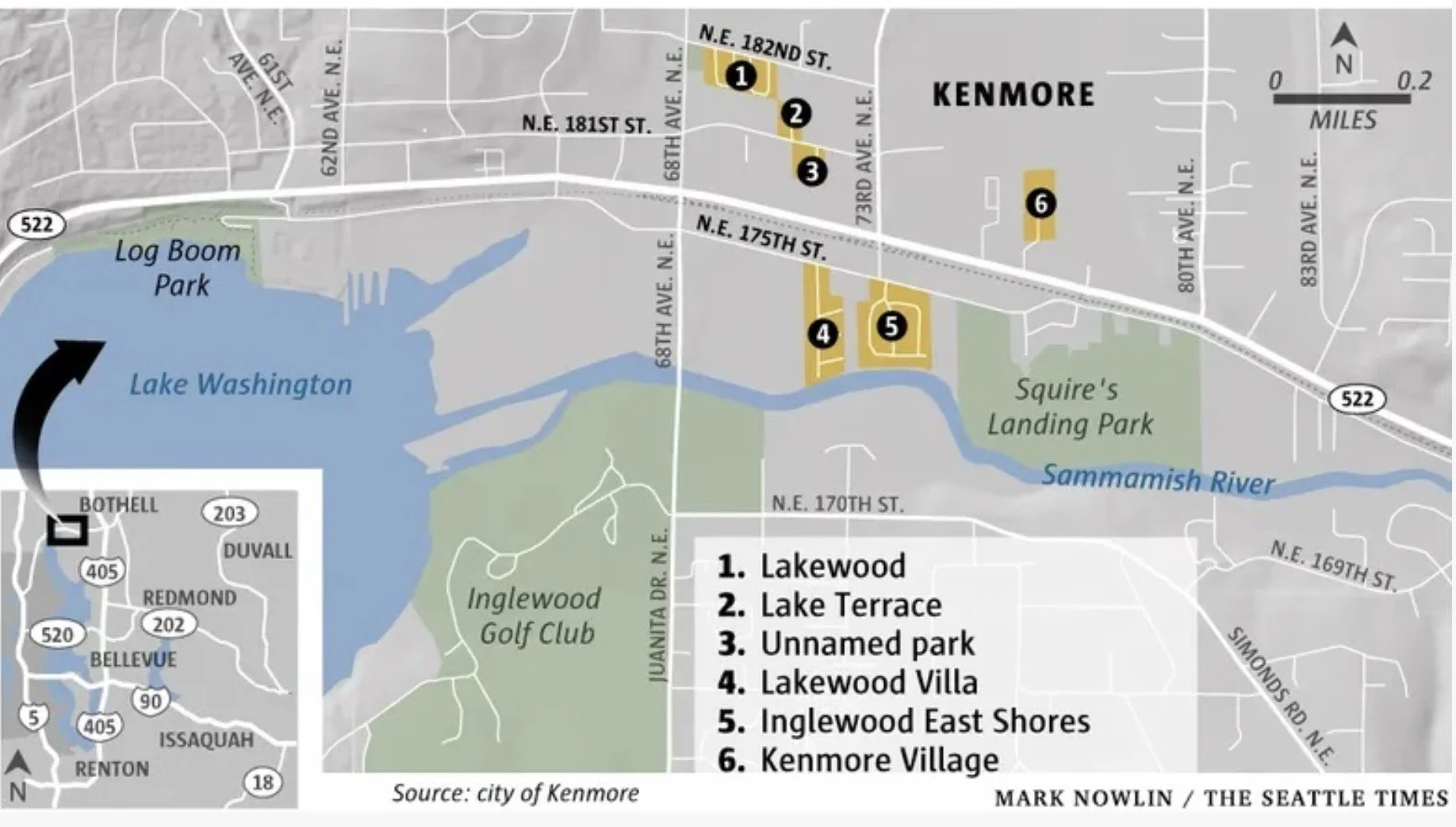
Commissioners discussed concerns of displacement of current manufactured home park residents; the MHPs are in areas zoned for higher density development, and C. Macias pointed out that the tenant protections the City passed have an end date. Several commissioners mentioned phased development to reduce displacement.
Chair Banaszynski expressed that she wants to revisit tenant protections, institute community preference policies, and talk about relocation assistance. She also expressed interest in a community land trust buying the MHPs, or having them developed by a social housing developer. She wants to take advice from the DEIA committee and community groups and have a matrix to guide the committee on values-based decision-making. She wants to find solutions that align with our values and may want to look to other countries. She believes a lot of MHPs are located in flood plains.
C. Vanderlinde does not believe that we have the resources in Kenmore to offset this displacement and may have to look outside the community for resources. We need to have a plan in place, implement it, and be held responsible.
C. Macias observed that none of our communities are marked as high displacement, so community preference may not be possible unless we create incentives or a marketing strategy for community preference. She brought up that Bothell created a new MHP, and many residents like this structure since it gives a sense of your own SFH in the affordable, un-subsidized range. She asked if it’s possible to zone for new ones.
C. Lasalle questioned whether the solutions we’re creating would cause problems down the road when balancing density, affordability, and DEIA. He believes that where MHPs offer low entry-barrier access to housing, that is unsustainable because of extra fees. And, if this is not true affordable unsubsidized homeownership, he feels that they should be redeveloped with preference for the existing owners to the new units.
VC Dorian believes that we should only focus on Affordable housing in our Housing Strategy Plan; not all types.
Staff and ARCH provided some clarification on Commissioners’ questions:
Todd: The city zoning allows the location of the MHPs; we have no control over maintenance or operations. MHPs are a low barrier and easily accessible, but rents can be raised at 5% annually, which prices people out. The owners rent the land and own their units; the challenge is when the units age, they don’t always have funds for repairs or replacement.
Andrew: Not owning the land in an MHP is an issue. There are situations where homes are built on leased land. With manufactured homes, I don’t think you can now prohibit mobile homes from being located in places where single-family homes are allowed as long as they are on permanent foundations. It’s really the ownership element that is the important thing to focus on. There are models that non-profits have had that convert the current structure to more of a co-op; it takes work.
Regarding social housing developers, this is coming into vogue because they’re focusing on 100% affordable housing. The challenge is you need more equity if you just have 50-60% AMI. You can cover more expenses. Where the Seattle social housing developer is exciting, social housing is not a silver bullet.
STEP Housing
PC discussed siting and development requirements of STEP housing as it relates to the housing plan. Recent legislation put additional guardrails on what the City can, and cannot, require. Several commissioners did not seem to realize that Council had already reviewed the recommendations of the STEP Committee and directed staff to draft code.
C. Macias asked about the small STEP project ARCH funded in Juanita. It’s a single-family home being converted into STEP. She pointed out that we are coming full-circle into what the STEP housing committee recommended, and why we’re looking at neighborhood commercial, to encourage services throughout the cities. We passed single-resident occupancy (SRO) units which enable conversion of residential homes into these smaller projects. Bigger projects require bigger funding, but there’s a way to get these smaller units in. She pointed out that Council already directed staff to draft the STEP code based on committee recommendation.
C. Lasalle wanted to know more about supportive services, because any deeply affordable housing needs it, and whether these services could work when clustered for smaller developments. He would like to see a clear vision of what Kenmore plans to do with STEP housing; how and when, and how we follow through. In the past he believes maybe there were some breakdowns in that vision. He wants to encourage site-selection to be close to transit. Of note, in light of the previously aborted project, C. Lasalle said that he does not “want the developer to do any further community engagement.” He wants to urge Council to do outreach and education starting now about what PSH is and is not.
Mike said that ARCH has funded a number of smaller projects over the years (in addition to other funding sources), and that clustering services can work. There is the Friends of Youth campus in Kingsgate that operates as a campus, though it is transitional housing (not permanent).
C. Olson had questions about what type of STEP works at what scale, what the conversion cost and hurdles are (for existing buildings) and whether there’s a cost per bed calculation. He would like to see clearcut code, and if there’s an exception he would like to have it codified.
VC Dorian said the following, via the clerk: “In the existing housing strategy plan, a tier-one priority was support development of emergency and permanent housing with services for homeless individuals and households. Unfortunately that didn’t result in a positive outcome for a project we all know of that was meant to do exactly that in Kenmore. On smaller housing we need to contact and talk with Porchlight about whether they could or would want to bring their model to Kenmore, otherwise it’s just magical STEP Housing.”
And, regarding neighborhood retail, VC. Dorian said, via the clerk: “Just a note on the residential retail. I don’t believe the services provided to residents of PSH would be profit-making. The service providers would also likely be specific to those populations, ie, I don’t think the type of therapists that would serve higher income residents of Kenmore would often overlap with the therapists who have the specific training to serve members of PSH. In talking to members of the STEP committee, the reference to residential retail was a late add by only one member of the committee. I don’t think we should treat that as settled fact or even particularly well-considered input.”**
Chair Banaszynski parroted the recently passed State Bill and said there shouldn’t be any additional requirements for STEP above what is required of other housing types required in the same zone. She echoed C. Olson, that things need to be clear in our code. She recognized that STEP providers need money and would like to direct more funds to them, continue the human services position, and finish the human services strategic plan. She said that anything the STEP Committee recommended needs to be run through compliance with the house bill that was just passed because a lot of things that were recommended are not possible under the state law***. She wants to focus on the lowest AMI and largest developments because she doesn’t believe the smaller developments will meet the need fast enough. She wants to look to other communities about what has been effective for engagement.
** Neighborhood retail was recommended by one STEP Committee member (me) at the final meeting; no members objected. It was endorsed by Council when the STEP Committee presented their recommendations. Neighborhood commercial also has a history of support in middle housing discussions and the Love Where You Live project. Neighborhood Retail | City of Kenmore Washington The information regarding historical context of recommendations is on the city website, and was in previous presentations to the Planning Commission.
*** The STEP recommendations were reviewed for compliance with the updated State code, with consultant Nick Chen from Kimley Horn, at the 3-16-26 City Council Meeting (after the streams discussion). Chair Banaszynski was present and seated in the front row. As C. Macias correctly noted, Staff is already drafting policy for Council to review.
