
March 16 Council Meeting
Cait’s Council Comments 3-16-26
Public comments
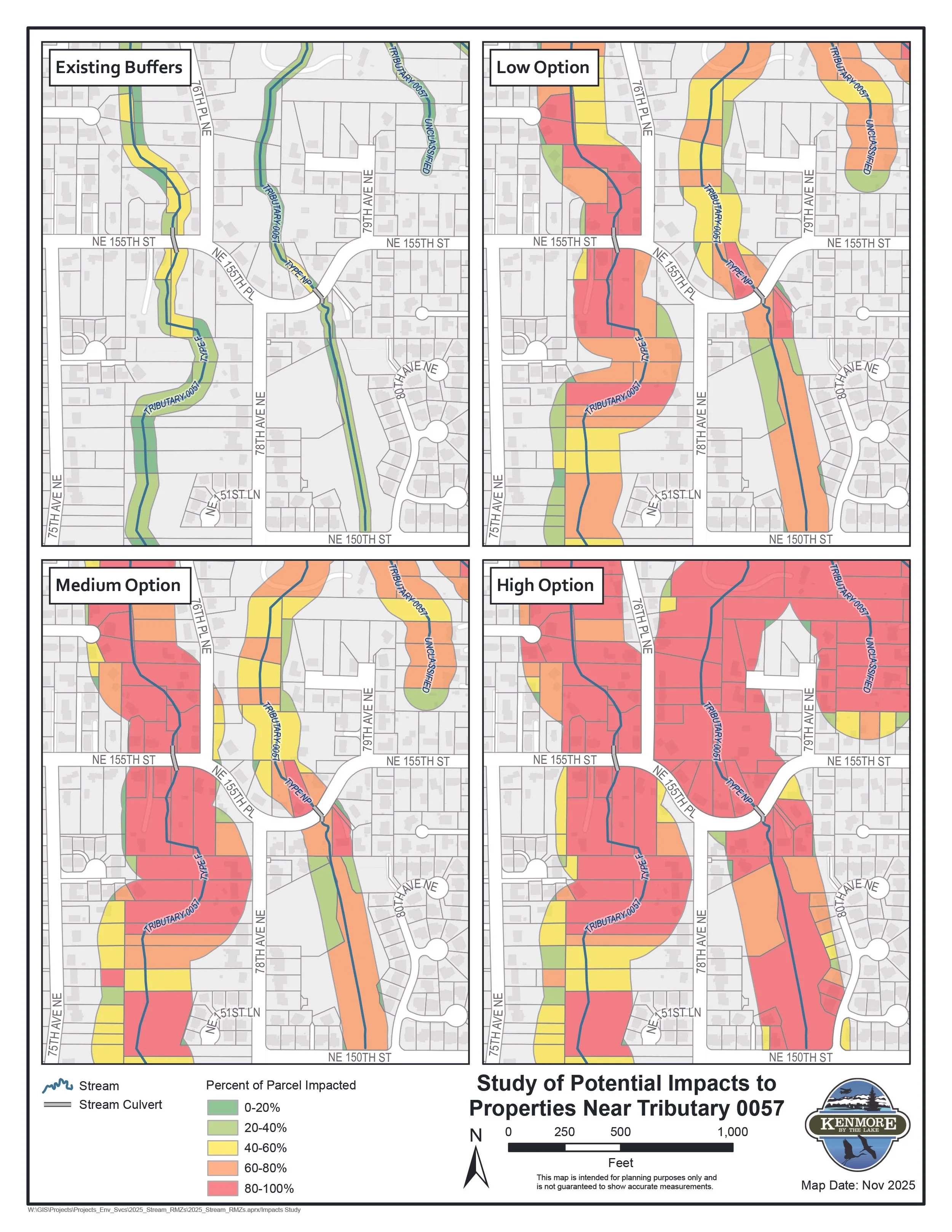
The majority of public comments were on the stream buffers/critical areas ordinance (CAO). Themes that ran through centered around seasonal streams and drainage ditches being labeled as “fish-bearing” when they were not, and concern/confusion around the impact on what people could do with their property when it’s encumbered by a buffer. The majority spoke in support of Option A, though there were around five who spoke in favor of Option C (the most extreme option).
Regular Meeting
Maurita Coburn presented on the recreation programs. Kenmore provides facilities and park spaces and partners with organizations, facilitates events, and works with public works.
Alison Jenks reviewed the 2025 events and volunteer activities that Kenmore hosted. Kenmore is no longer managing the farmers market, but the Kenmore Quad is now a City event.
STREAM BUFFERS - CRITICAL AREAS ORDINANCE
Debbie Bent and Todd Hall presented the three buffer options, the approaches of other cities, parcel impacts, and reduction options. They also reviewed the survey results. Alex from Facet (our consultant) was also present, as well as Morgan from Washington Dept. of Fish and Wildlife (WDFW).
Every 10 years we are required to update our critical areas ordinances under the Growth Management Act (GMA). Kenmore’s was due late 2024 but we’ve gotten two extensions. The updates at hand are riparian management zones (RMZs/stream buffers);Swamp Creek is not included since it’s regulated by shoreline regulations (coming later).
Staff mailed out over 900 letters to impacted property owners, and received 87 responses – 85% of the respondents preferred Option A. Only four residents selected each of options B & C.
Q&A:
Councilmember questions were largely aimed at understanding the impact that the buffers would have on property owners, the environment and housing. They also discussed incentives to encourage property owners to improve the riparian environment.
Impacts for property owners: When a property becomes non-conforming, it can continue as current use until the owner wants to make a change, then the non-conforming standards would apply. Homeowners could not subdivide property that is entirely encumbered; the reasonable-use exemption for the property would be one single-family home. Mayor Herbig asked if we could use form-based code to allow owners to redevelop a duplex (or other use) in the same footprint instead of a single-family home. CM O’Cain asked about how many property owners impacted had put forth permits that would have not been allowed under the expanded buffers, and what the impact on property tax and values would be.
Incentives: CM Marshall asked if there is a current setback for piped streams (seems to be 25’) and if we can incentivize homeowners to daylight them.
Miscategorized streams: CM Loutsis asked about the dispute process. Outside of development, Alex and Morgan said there’s a process at the State level (WAC 2022-16-030) that speaks to that. The mapping that WDFW does is high-level, and they’d have to do a field visit to determine specific characteristics. Debbie said that if this comes up in the permitting process, it will be resolved then.
Typing data for the streams came from WDFW and DNR (department of natural resources), as well as field-verified data.
Housing Capacity: CM Adman and Mayor Herbig both inquired about impacts to our housing capacity. Staff said that we were assigned a growth target, and that it showed “excess capacity.” However, they also admitted that this didn’t take into account private covenants (single-family deed restrictions) and they don’t know the impact of those. Mayor Herbig asked if 30% of our parcels being tied up with protective covenants combined with 20% of parcels being impacted by stream buffers would impact our ability to meet our housing targets. Staff could not answer. DM Sasson said she believes we have enough single-family housing and wants to see increased density on currently-developed spaces, rather than new ones being developed.
Current Stream Health: Mayor Herbig asked about stream health, and how the buffers currently function. Alex/Facet said they did not know. CM Adman said there’s a resource called BIBI that indicates that Kenmore’s streams aren’t doing that well. Mayor Herbig asked if a restored, functional buffer is better than just wide open space. There was no answer.
Best Available Science: CM Adman asked WDFW to comment on how the options are consistent with best available science. WDFW said their official recommendation is Option C. Alex/Facet said that BAS is supposed to inform regulations, but it is used to balance other priorities not as a mandate. Mayor Herbig pointed out that the studies that are used to determine STPH were published 1925-1989, so this wasn’t new science. WDFW said that they didn’t have specifications for urban streams previously, so this was newly synthesized.
WDFW is here as a resource and technical advisor providing information to use in these updates, but they do not certify or approve the plans.
Exemptions: Mayor Herbig said that we have heard from a lot of property owners who bought when they were hoping to expand their homes, or build an ADU and taking this away is a big thing to do to folks. He is hoping that we’ll explore exemptions, and broaden the exemption for expansion to all homes and not just those built before 1990. He would also like to give people credit for keeping their buffer ecologically functional. He wanted to explore other flexibility with setbacks if people are constrained by the buffer. CM Sasson lives on a buffer and spoke about adding to her own home so it would be comfortable for her family, acknowledging that without exemptions others would not be able to do the same.
CMs Adman, Culver, O’Cain, Marshall, Sasson and Loutsis all indicated they supported incentives to homeowners who are willing to restore their buffers / providing flexibility. CM Marshall asked to leave all options on the table, including A which had a lot of public support. CM Culver continued to express his vocal support for Option C, which he will be voting for despite community feedback.
STEP Housing
Debbie and Nick Chen (Kimley-Horn consultant) Presented. New legislation (HB2266) dictates that you can’t have different regulations for STEP than you can for residential housing. This restricts many of the STEP Committee's recommendations, including Good Neighbor Agreements which cannot be required by the city (though they can be put in place by operators). Nick provided some guidance on how to allow STEP on church properties and lower parking requirements. HB2266 would also not allow on-site services to be required, but a lot of providers do it as part of their mission. For smaller projects, we need an allowance for corner stores (currently with the planning commission for discussion).
IF the city is providing land or funding to a STEP provider, then the city could require a separate agreement, including a good neighbor agreement. Otherwise they cannot.
Next steps are public hearing and ordinance adoption.
CMs Marshall and Loutsis asked to see the draft code before it goes to a hearing. Staff will begin drafting the code.
STAFF REPORTS
Staff presentations were rescheduled because it was 11:22pm.
Teri Kilgore said there is a council retreat this weekend where they would talk about upcoming priorities and fiscal strategies. These will be available online.
CM Loutsis thanked public works’ Jennifer Gordon for going to Kenmore Middle School with him for Career day. Regarding Sound Cities Association's King County Transportation district tax, and the committee is asking for 25% of the tax revenue to be returned to cities.
Mayor Herbig said the trip to National League of Cities has been productive. He is scheduling a meeting next week with the Army Corps to discuss Sammamish dredging next week.
