
May 5 Planning Commission Meeting
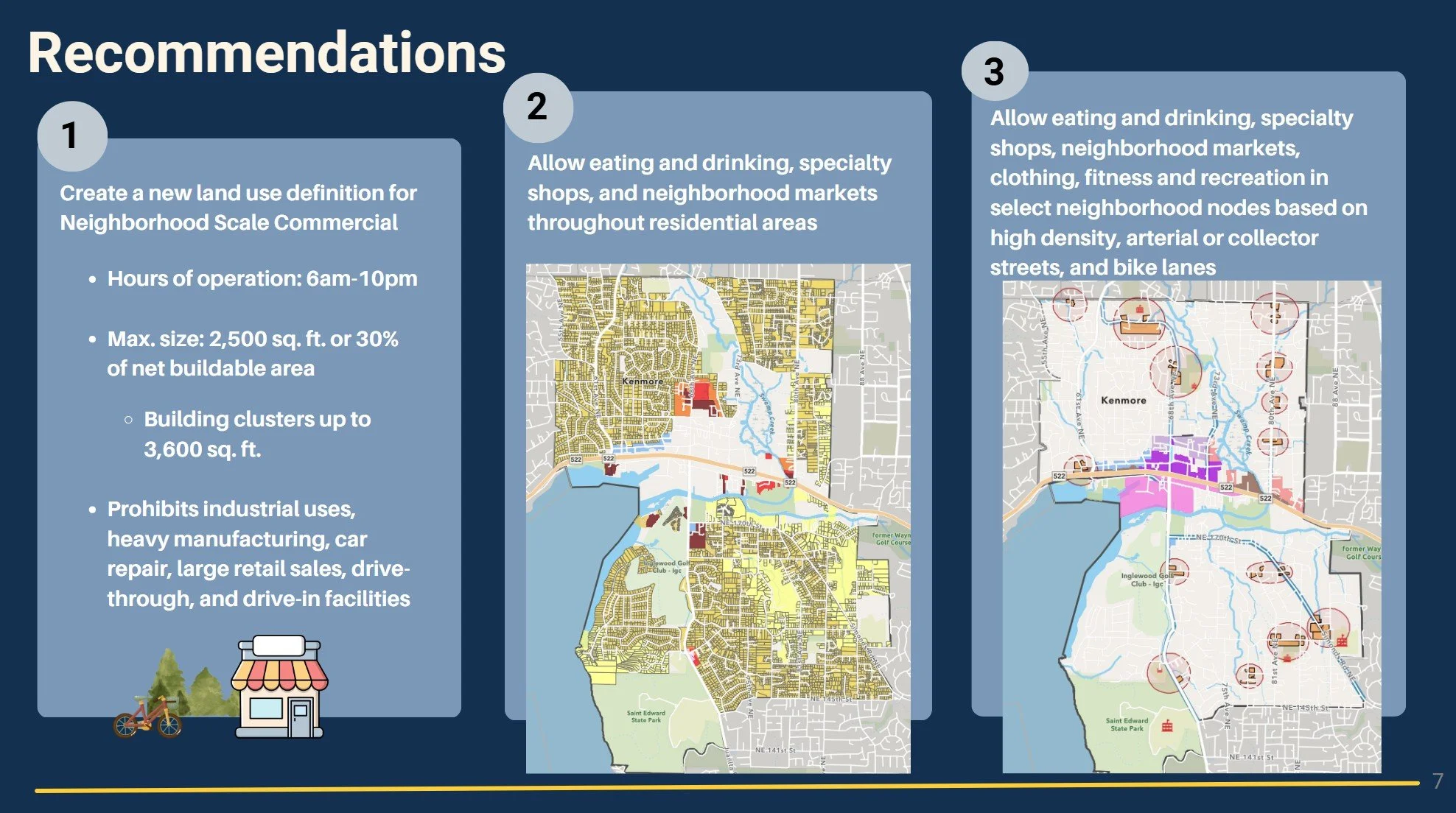
Brittany Chue presented community engagement results regarding corner stores and neighborhood commercial. The survey received 173 responses, with 76% of respondents supporting neighborhood commercial. Staff is asking for more feedback on where these would be located, since initial survey results didn’t show a clear majority. Staff made several recommendations, including hours of operation (from 6am-10pm), a maximum size (of 2,500sf or 30% of net buildable area), and to prohibit industrial uses. Staff also presented options of allowing a variety of uses throughout neighborhoods with more intensive uses in neighborhood “nodes”. The “nodes” were not previously discussed by the Planning Commission; the map was created in response to the survey, and the intent was that these more intensive uses (#3) would be in addition to more widespread uses (#2) throughout the city.
Staff Recommendation Discussion
C. Vanderlinde expressed a preference for allowing more widespread use (#2), and thinks that the nodes (#3) need to come back as part of a larger conversation about economic development. His concerns centered around keeping use in scale with the neighborhood, and believes that some commercial uses need to be located near density or infrastructure, such as bike lanes. He asked staff to give respondents option to rank the #2 and #3 maps on a scale of 1-5. He believes that the city needs a way to vet businesses.
C. Thompson expressed a desire to keep scale consistent with the neighborhoods, and believes that some neighborhoods can take on larger businesses than others. He visits a fitness studio that is in an ADU and doesn’t believe a use of that size impacts the surrounding residents, the same with the sip + paint studios. He would like to give people some opportunity to scale their businesses. He believes that residential density is a separate issue, and that developers could take a node and put it anywhere but it wouldn’t change the land values. We need to tell people what the noise code and the lighting code are.
Chair Banaszynski wants to know the weight of each concern expressed by members of the community and have it quantified. She wants to allow our residents to engage in the opportunities they’re best suited to, and believes undoing zoning makes sense. Her preference was for the nodes (#3) because she believes that it would be more of a guarantee that we would get businesses. She has concerns about the nodes as presented, so would like to develop them as part of a separate project. She wants to listen to what the land is telling us that it needs to be, and wants to look at what we allow with a duty of care and equity lens.
C. Macias asked staff for some clarification on ambiguous definitions, such as whether an art studio that sold handmade goods and taught classes would be an art studio or specialty shop. She voiced an all-in approach to allowing neighborhood retail; we don’t want to limit reach, since this limits traffic and diminishes opportunity for business. She pointed out that much of what we’re talking about home business is reusing existing structures.
VC Dorrian said that some of the nodes feel arbitrary; some aren’t in dense areas or near collector streets, and some are near wetlands. He expressed a preference for allowing more flexibility, doing their duty of care and then letting the market decide. For context, he offered that the reason cities (and the state) have looked at neighborhood commercial is that there’s a sense that zoning lead to unintended consequences such as denial of opportunity and public health consequences because of lack of walkability. Because of this, he’s cautious about adding more zoning.
C. Lassalle agreed with C. Dorrian, and observed that healthcare wasn’t on the positive or negative list of allowed uses. He expressed similar concerns about the locations of the nodes and their overlap with our critical areas. He would like to do some tweaking of the allowed uses. He supports widespread use (#2), and in order for that to be successful he thinks that we have to plan some densification. If we want businesses to exist we should encourage them everywhere – we can’t determine which corner can have a business and which can’t. He talked about wanting to pursue businesses to develop in Kenmore.
Conversions
New construction often involves infrastructure improvements (roads, sidewalk, stormwater) but interior improvements don’t trigger these requirements. Currently, businesses would need a “change of use permit” to do the conversion, which would increase parking requirements and may require sprinklers. New construction requires a pre-application meeting, site plan review, etc.
C Lassalle would like to allow flexibility, and wants to know what the barriers are to making that happen. Some conversions could be easy, some will be more challenging.
C. Vanderlinde thinks conversions should be treated differently when you keep the same footprint, and we should allow flexibility. Wants to allow the permitting department some discrection.
C. Thompson believes that if you have a business where you’re inviting the public in you have to have the same regulations as any other public establishment, regardless of scale. He doesn’t believe we should cut corners on public safety; safety of constituents is his #1 concern. For improvements, he thinks that sidewalks are the best example of a prohibitive requirement.
C. Macias pointed out that what we are trying to do is encourage small business, and most of those businesses can’t afford the architect, engineering, etc., that’s required to bring an existing structure to commercial standards. She would like to see a way to convert an existing building (or portion) without full compliance. Anything food-related falls under the department of health and has to meet separate standards, so this isn’t a concern for the City to regulate. She also pointed out that many of our own homes don’t meet current code.
Chair Banaszynski said it’s important for us to ensure safety for people who are frequenting businesses but shares some of C. Macias’ concerns about the cost barriers, and recognized that frontage improvements would make this unattainable. She does not want to reduce stormwater compliance requirements for new construction because stormwater is a huge problem.
Operating Hours
VC Dorrain thinks we should establish a baseline that regulates all activities of business, and that it should not vary for uses. C. Vanderlinde and C. Lassalle agreed.
C. Macias asked for clarification about the noise ordinance. She pointed out two uses that may require someone onsite outside of business hours; a kennel and a bakery.
Sign regulations
Signs are currently regulated by type and zone; the city cannot discriminate against certain businesses with regard to their signs.
C. Thompson expressed that signs disrupt the livability of a community and are a major change in the neighborhood. He doesn’t see the value of signs for neighborhood businesses. He supports only small signs, lit when the businesses is open, nothing in the right-of-way. He doesn’t want the neighborhood sign ordinance to open the door to downtown businesses plastering A-frames everywhere.
C. Macias said signs can be discreet and was less concerned about the signs because we already have sign code. She pointed out that with neighborhood businesses, customers need adequate signage to ensure they’re at the right place.
Chair Banaszynski said that there’s nothing like a sign to make people go completely ballistic. She is in favor of wall signs, not freestanding because they add impervious surface. She has a strong dislike for the corrugated plastic signs because they are really terrible for the environment and she “dispairs” that she has so many in her garage. Once these plastic signs are in existence they are here forever; they break down into smaller pieces but don’t go away.
C. Lassalle said is concerned about pavement use for A-frames limiting pedestrian use, as well as unlawful parking on the side of the road.
C. Dorrian read our sign code for residential areas. He believes that the public will have concerns, and we may want to package this up and present it to the community.
Next steps:
May 19 discussion - results from the open house
June - draft code
September 1 - Public hearing/recommendation
October - recommend to council
