
June 16 Planning Commission Meeting
Cait’s PC Corner - 6-16-26
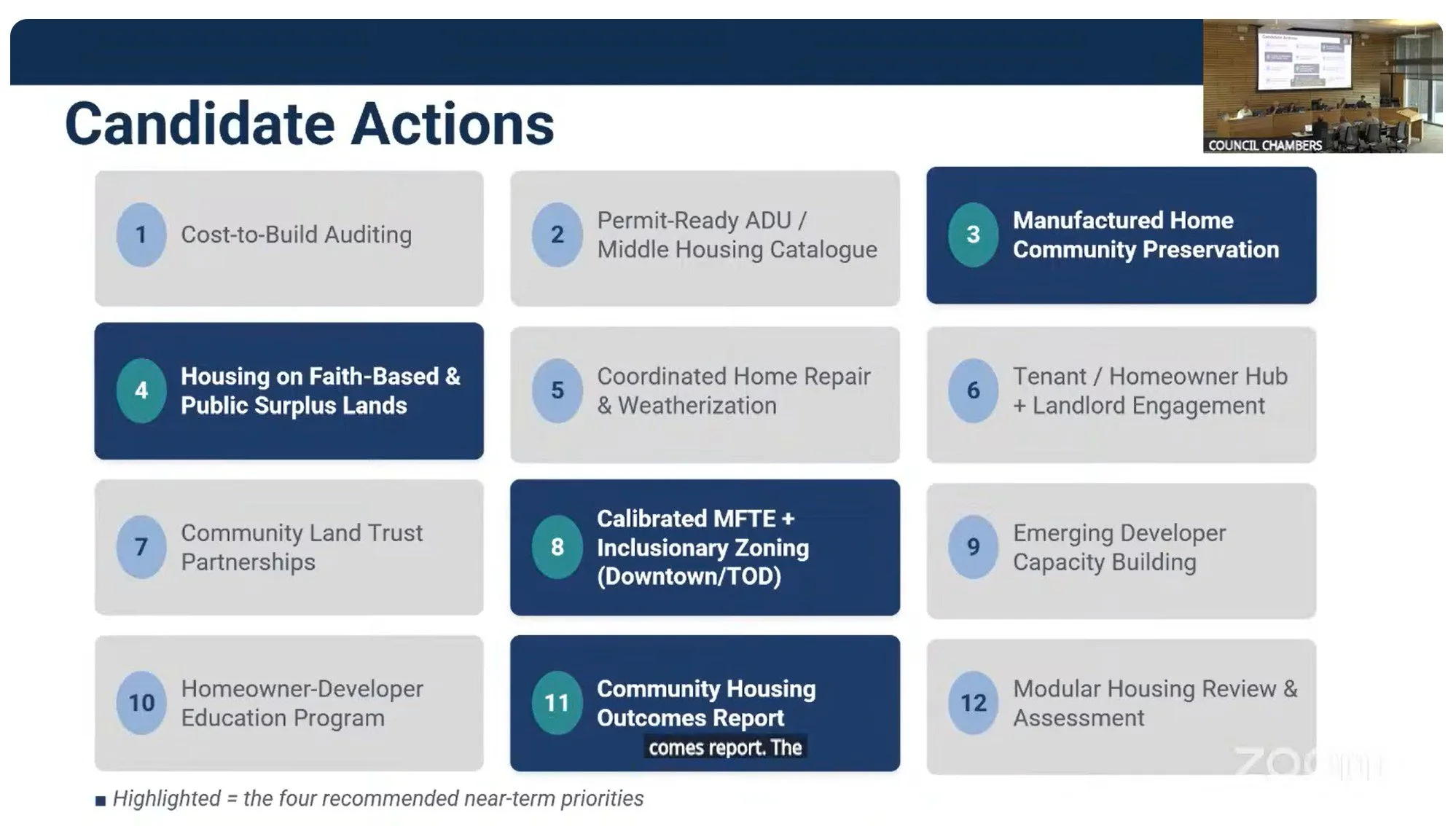
Todd Hall presented on the Housing Strategy Plan (HSP). The objectives for the meeting were to confirm priorities, direct the sequencing, and authorize scoping. The first HSP was in 2017 and most of those goals have already been met. Staff used a logic model to link resources to results; the Planning Commission’s role is to decide what activities may best achieve the desired outcomes. There were 12 actions that Staff whittled down to four recommendations; the other eight are on the table for later phases of the work program. The meeting is to determine what priorities are leading the work. They used six criteria for evaluation including cost, capacity, efficacy, alignment, time required and schedule.
Recommended by Staff: manufactured home community preservation, faith-based/public surplus lands, calibrated MFTE+ (multi-family tax exemption) Inclusionary Zoning, and Community Housing Outcomes Report.
Andrew from ARCH overviewed the logic model.
General Discussion
C. Lassalle said it would be great to have an overview of how the different initiatives would impact the different levels of affordable housing. While the four selected seem good, but we need to make sure that they meet our targets and if they don’t, we would need to add additional items from the actions list. What is the expected outcome? And do they meet it.
VC Dorrian asked if they could see an analysis of what had, and had not, been achieved from the last plan. He would also like to know what is working elsewhere for affordable housing. He noted we have not built any STEP housing from the last plan, and we could look at small-scale STEP housing, and small houses on small lots. He recently realized that we can also use the HSP for market-rate housing, but doesn’t feel we are hostile enough to developers that we need to move the focus of the plan away from government action. He wants to be able to identify what has and has not worked, and how we make the most of our existing zoning.
C. Vanderlinde asked what they are trying to accomplish with the manufactured home communities, and whether the intent is preservation or to make way for another housing type that is not manufactured/mobile homes. He believes builders will never provide sub-market rate housing. If you want to have it, there are going to have to be publicly funded incentives to make it happen. He wants to know what has worked and what doesn’t. If the conclusion is that we have all these options but we can’t tell you that any are going to be effective, that’s an answer too. These all cost taxpayer dollars, and we need to ensure we have the best and strongest options. If we don’t we are just recycling policy statements and we need to stop.
C. Macias looks at the HSP as production of housing in general and would like to see more housing of all types. Focusing only on one type boxes us into a corner. She likes the pre-approved ADU plans as well as the manufactured home communities. She asked about the Park & Ride that was identified in the 2017 plan, and how many units inclusionary zoning has gotten us since 2019.
Chair Banaszynski said that she wants #8 (MFTE/IZ) to stay on the list and thinks it would be her top priority. She wants us to focus on and enable housing at all affordability levels; we should put a spotlight on affordable housing because the market is going to build market rate housing but there are some levels of affordability that we are not going to meet.
Permit-Ready ADUs (Additional Item)
Several commissioners commented on #2, permit-ready ADUs. Their conversation was scattered throughout the meeting, and condensed here for clarity.
C. Macias likes the pre-approved plan for ADUs.
C. Vanderlinde said he also likes the permit-ready ADU catalog. He believes that there is federal funding, and that this type of activity has been fairly productive elsewhere. It takes time to develop; you don’t see results overnight. He noted that many users of the pre-approved plans are families, and it helps them overcome a significant barrier to entry and removes friction. Pre-approved plans deliver a good return on investment and can deliver that productivity in a 2-3 year time.
C. Lassalle echoed what C. Vanderlinde said about ADUs, and would be consistent with the City’s work on middle-housing/ADUs. It would make a great 5th priority.
Chair Banaszynski said that she likes the ADU catalog but when she did her research the uptake was very low; in Seattle 13% of ADUs were pre-approved plans. Her understanding was that the ADU plans could only be used exactly as presented, and if the homeowner wanted something different at all then they couldn’t use them. She would be willing to elevate this if there’s a resource for it, and noted there are folks in LFP that are interested in it. She later noted that she likes this as a 5th priority.
C. Olson commented on the interrelatedness of #2 and #9. Other jurisdictions have allowed for newly-designed ADUs to be submitted so they can be used as a pre-approved design going forward, and we want to encourage both local development and ADUs.
C. Macias asked if we could loop-in development partners and allow post-permit revisions, so that there is more flexibility on plans and they don’t have to be used exactly as presented. Debbie said that they should be consistent, easy to use, and have some flexibility built in (so, yes, to C. Macias’ question).
Cost-to-build auditing (additional item)
C. Olson asked about #1, cost to build auditing. He would be curious if there was a less-intense approach that might bring the timeline up on that since the faster we know what is limiting housing production the sooner we can address them, and the more housing production we can get. Andrew said that was a comprehensive examination over the lifetime of development and would likely require an outside consultant to do, and that would be an expensive and time consuming project to do correctly. You could do a more limited version. C. Olson would be interested in seeing a review of frontage improvements.
Chair Banaszynski said that the cost to build auditing could get at some of the things that the PC has most immediate control over, such as our zoning and code. There are things she’s been told are a barrier to development such as frontage improvements and parking. Debbie said that if a private development is doing public improvements there has to be a nexus - the level of development has to be big enough to require it.
Community Engagement
VC. Dorrian asked how BIPOC communities are co-designers, not just consulted in name. He would also like to add the housing insecure. He asked about outreach and engagement on these options. Staff reminded him that these are strategies, not actions, and engagement will occur at the next step.
C. Thompson worked as a surveyor when he was really young and went door-to-door and asked people what they thought. It wasn’t that expensive; he suggested that we do this in Kenmore.
Adding a 5th Priority
Chair Banaszynski heard a lot of support about ADU/middle-housing. She wanted to add #6 (Tenant/homeowner resource hub and anti-displacement engagement). If the ADU/middle housing catalog can’t be number 5, perhaps it can be a Tenant/homeowner resource hub. She believes this could be low-cost and support the most vulnerable or housing insecure and build on the work that they did on tenant protections. She asked how the priorities were addressing STEP.
VC Dorrian said that the 5th for him would be STEP Housing. We haven’t achieved it, there has been push from council members that we pick it up again with focus on small scale.
C. Lassalle supports STEP as well. His 5th would be ADUs. He would still like for our next conversation to have a deeper dive on how we are expecting each item to impact our affordable housing targets and vision for Kenmore in years to come.
C. Macias said the 5th would be permit-ready ADUs. They spent seven months looking at middle-housing and rezoned the entire city to allow ADUs, and this would be the next step in continuing that work.
C. Thompson likes the idea about manufactured housing and looking at it vs. other options for affordable housing in the same location.
C. Olson wondered if #11 (community housing outcomes report) should be #1 on the list because it gives a data framework, then we pick four more. He asked if there was appetite to expedite #11. He would add ADUs if there’s a strategic reason.
STEP Housing & Affordability
Chair Banaszynski said the list feels incomplete, and is missing STEP housing, which is important to our community. It’s important to view these all through a DEIA lens to make sure we are centering that priority. She wants clarity on the plan as a whole again, and to see what bands of affordability each item is addressing to get a better idea of whether this helps us build all levels of affordability. She would like to have a conversation about the other eight items on the list as well.
C. Olson said he’s happy with the four selected; affordability is addressed through MFTE/IZ and faith-based/surplus lands.
C. Vanderlinde would like to see explicit discussion on the demographic trends that are impacting housing, including aging community, and economic development.
C. Thompson believes if we just count housing production we are not going to get affordable housing. That has been proven over and over again.
In response to a question from C. Thompson about adding STEP as #13, Andrew pointed out that STEP is more an outcome than an action item, and what we are working on is a list of action items.
Chair Banaszynski went back to the list of questions and asked Staff what questions they feel that they have not answered so far. Andrew said that he had everything he needed.
The meeting continued for approximately one additional hour, with VC Dorrian asking questions about the process. He expressed that he felt they were speeding towards a conclusion. C. Lassalle echoed these concerns. Staff continued to remind commissioners that this was the start of the discussion, the prioritization of where to start does not negate the rest of the priorities, and that they could come back with more information for further discussion if desired.
UP NEXT: More neighborhood retail, and HSP, capital facilities.
