
Sept. 14th Council Meeting
STREAM BUFFERS STUDY SESSION
The meeting started at 5:30 pm with a “study session” about stream buffers and our Critical Areas Ordinance (CAO) update. The goal was to provide an informal setting where staff could level-set, clear up confusion, and answer any questions from Council. Staff presenting were Debbie Bent, Todd Hall, Richard Sawyer, Sam Loyuk and two consultants.
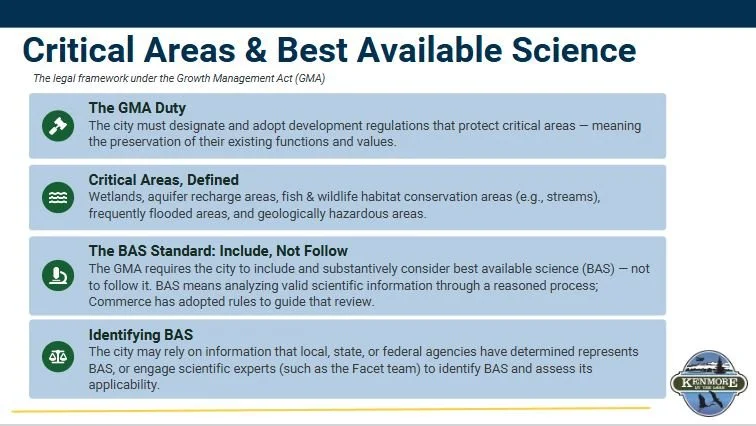
Why are we doing this? The City is required to periodically review our critical areas and ensure that we are protecting their function and values. In doing this, the City is required to substantively consider (not necessarily follow) Best Available Science (BAS). Multiple sources of BAS as well as non-scientific evidence can be considered. If we depart from BAS, we have to document it in the record and show how it was considered, and how we are still providing the protection for critical areas. Deciding which approach is best is up to the City.
What is a stream? WAC 222-16-030 sets the definition because this is a regulatory question, not just a visual one. State code both defines a stream and what is required along the riparian (land along a river) zone. The types of stream are broken into fish bearing (larger streams, main chanel, Type S), potential fish use (Type F), and then streams that don’t support fish (seasonal or non-seasonal, Np or Ns). Scientists look at the “bankful width” (width of the stream), slope, mapped fish use, barriers, and studies to determine if a stream can be fish habitat. They’re looking for 2’ or more for 525 linear feet to be considered fish-bearing; natural barriers and channels can determine whether a stream is fish-bearing. Piped streams can be a stream if a historical stream was in place and routed through the system.
As an example, Tributary 0056 has 60 culverts, at least 40 of which prevent fish passage. If the culverts or barriers are human-caused and the waterway can be mitigated back to a stream, then it will still be considered fish habitat. The criteria for fish use is based on the natural characteristics, not the man-made ones because those can be changed. The criteria mostly applies to anadromous fish (fish that go out to the ocean and come back) since they need the stream for passage.
A biologist from WDFW came out and looked at a section of Tributary 0056 showing Type N, showing that streams can be fish-bearing at a lower part, then non-fish at a higher part.
Richard presented photos of several streams including Sammamish River Tributary 1; consultants from WDW have gone out and looked at it and they are replacing some barriers there. A stream can be dry 9 months out of the year but along as it is wetted in spawning and rearing seasons it can be fish bearing. This is so close to the Sammamish River that if there’s one big rain day, salmon will swim up.
CM Culver said he was “asked to prepare questions” –
He wanted to point out to staff that the code says (RCW 36.70a.172 (1)) it’s supposed to give special protection to anadromous fisheries.
He quoted a supreme court case in Ferry County about science that supports anything below Site Potential Tree Height (SPTH). Debbie said this isn’t on the discussion tonight; we have, but it will be presented at the November meeting when we bring back the options.
He wanted to know how the “departure record” from BAS is utilized in practice. Debbie said we have to document the information we’re relying on, how it impacts the critical area and if we are using any mitigation options. It is used to inform policy direction and regulations. CM Culver asked if this is used in the appeal process. Debbie said that the appeals go to the Growth Management Hearings Board (GMHB) and they determine whether the updates conform with the Growth Management Act (GMA). CM Culver brought up a 2016 case where Kenmore had code appealed to the GMHB and our legal bill doubled that year; he cautioned staff to be careful.
He cited WAC 365.195.900 (3) that says that Cities can’t ignore BAS in favor of science it prefers; he also cited Ferry County again. He wanted to call out that Cities must consider and include BAS in the CAO and this is especially important to salmon recovery. Debbie asked if there was a specific comment here because she just heard a lot of commentary.
DM Sasson said that it’s important that we are protecting habitat instead of the presence of fish.
CM Adman asked about stream typing and what happens if someone disagrees with the stream type on the map. Richard said it usually comes up during development, and the homeowner hires a biologist to determine whether it’s accurate or not. Homeowners can also call his department and they could review material and reach out to WDFW. People can also reach out to WDFW directly.
Buffer determination methodologies: Todd presented the methodologies. The traditional approach is a fixed width buffer on either side of the stream based on the flow characteristics (perennial vs. seasonal) and stream type (fish or non-fish). This is the “water typing” approach. The Riparian Management Zone (RMZ) approach is driven by land characteristics.. This is, instead of asking how valuable the stream is, it asks how tall a mature native forest (at 200 years old) would grow along the stream corridor given the soil conditions, and sets that as the width of the buffer.
DM Sasson said that the methodology change from a fish conversation to a mature forest conversation was important and hasn’t been communicated adequately. Debbie reminded her that the mature forest conversation is just one scientific approach; the fixed buffers are still grounded in science. Both approaches are valid.
Sam Loyuk asked if a type Nf or Ns would increase the buffer if we used the standard buffer for SPTH. The answer is yes, it would increase them, because the SPTH approach sets the same larger buffer regardless of the characteristics of the stream.
CM Loutsis asked about piped streams where there is a lack of natural habitat, and what the benefits of extending the buffer while the stream is piped are. The consultant said that there are some jurisdictions that require buffers or setbacks around pipes, which helps to determine where new development is located so it could be daylighted in the future. A piped stream can be removed from a pipe.
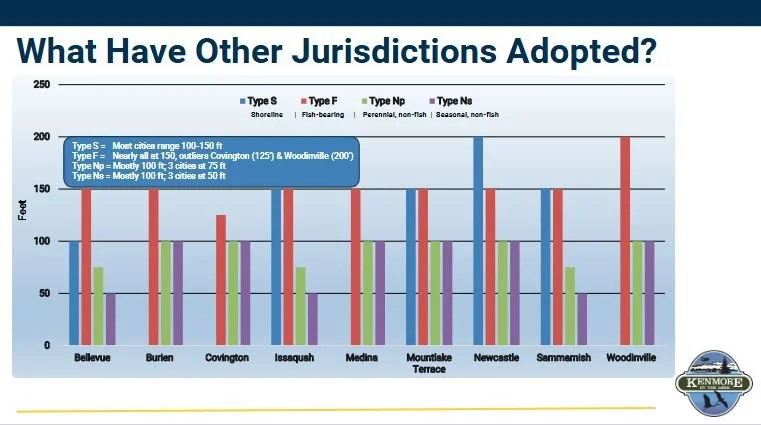
What have other cities done? Most of our peer jurisdictions have NOT adopted the RMZ approach (SPTH). Staff presented options for buffer enhancement and reduction that peer cities have adopted, as well as restoration incentive options that cities have offered for reduced buffer width.
Mayor Herbig asked whether this flexibility could be incorporated now.. Debbie said that some areas did their full Critical Area and Shoreline Master Plan update together (Kenmore’s deadline for this is June 2029). If Council wants to put in flexibility options they need to do it now.
CM Adman requested more details on the flexibility options. Staff will bring the flexibility options as part of the code update, and invited Council to contribute if there were options they wanted to see. Regarding incentives for the SPTH approach, the consultant said that the other areas they’ve worked with use SPTH as is. Jurisdictions that use water typing have updated their buffers with incentives, focusing on a 100’ minimum for water quality, and then approaching an average value for SPTH.
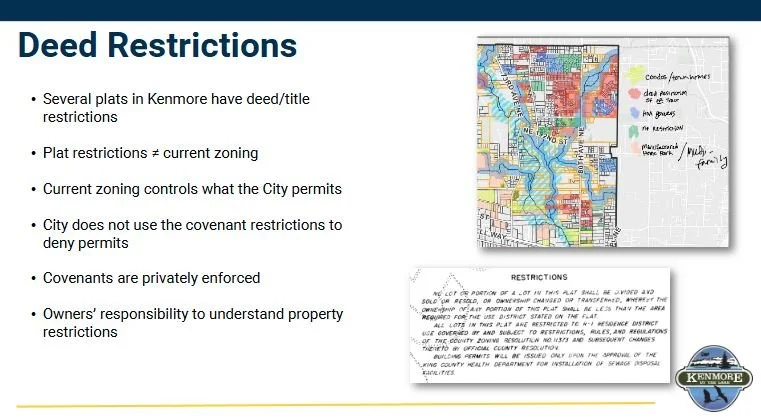
Impacts on Housing Goals: Staff also talked about deed or title restrictions and noted that these are different from current zoning. Zoning controls what the city permits, but there are additional restrictions in place that determine whether we are able to meet our housing goals. Kenmore, for example, has a lot of private covenants that restrict what can be built. Covenants are privately enforced and are up to the property owners and their HOAs. It's the owner’s responsibility to understand. Additional restrictions outside the City’s control, such as critical areas and encumbrances, also impact how a property is used and our ability to meet our housing goals.
CM Adman asked how the deed restrictions relate to the stream buffers discussion. Debbie said that what this illustrates is that we have finite land and we are trying to prioritize; we are trying to protect the environment and have land for growth. If you put a large buffer there, that’s great for environmental protections, but then there’s less available land to meet our housing goals. A lot of the land that is left is restricted for development (ie, only allows one single family home, or restricted on height). There are competing priorities – whatever stream buffer council sets, there are other impacts to consider outside of what the city regulates.
CM Marshall asked if we can require a property owner to put a deed restriction on their land about restoring the critical area. Debbie said that this is usually part of a tract or native growth protection easement, and there’s a portion of the land that is set aside. That creates a clear designation of where you can and cannot do certain things.
CM Culver said that it’s already been decided that we have enough land capacity to meet our housing goals. Debbie said that it’s a matter of type - you probably have enough capacity, but we recently adopted middle housing goals, and those are allowed in single-family zones, which is where most of the stream impacts are.
Other Comments:
CM Culver said that Anacortes lost their GMHB case and then adopted SPTH case. He said 150’ has lost at hearings in Skagit and Snohomish County and they were both remanded to fix. He pushed to move this forward with a “straw poll” and expressed his desire to move forward with SPTH
CM O’Cain [mic wasn’t working well, expressed concerns about the community and residents]. There is an equity impact with the RMZ approach; houses near each other can have very different buffers, and that’s something that we should pay attention to. She thinks our city deserves to have us give this more consideration.
REGULAR MEETING
Proclamations: National Recovery Month, Suicide Prevention Awareness, Hispanic and Latino Heritage Month, Student Poet Laureats Day, National Diaper Need Awareness Week
Where’s the fun? Summer concert series, Play Day on August 15th, Movies in Town Square, Kenmore Art Show, Kenmore Quad, Staff BBQ Potluck. Mayor Herbig said he was at every single event this summer and they were fantastic.
Public Comment:
Steve Yoder expressed gratitude for Kenmore sending officers to go to “Pipe down” training to address noise pollution for modified exhaust systems and noise violations.
Three commenters spoke in support of “option C” for stream buffers.
Tracy B said that we need to stop pitting the environment and housing against each other. She talked about the status quo, late stage capitalism and neo-liberalism. She wants to adopt WDFW’s RMZ approach and increase density in other parts of the city. She believes that we have more than enough capacity for housing. She doesn’t want the City to pay a consultant to analyze the science and said that the paid consultant would have a vested interest in not adopting WDFW’s approach.

AIR QUALITY
Christine Cooley, director of Puget Sound Clean Air Agency, presented. They have air quality monitors in the Kenmore area, which are especially vital during air quality emergencies. They are releasing an electric vehicle charging plan this fall to help the City plan where to put chargers, and they will have a plan to help promote regional climate action.
Fine particles, PM2.5, are an important air quality concern, and this is what their air quality network monitors. You can’t always see it or smell it; wood smoke and exhaust are major sources. Kenmore’s air quality is pretty good. They have an incentive program for people who have old wood stoves to trade them in. Kenmore has better air quality than the average community
Industrial sources are less than 10% of the PM2.5 in Kenmore. There are 11 registered sources; 5 are gas stations. The local asphalt plant is one source, and they are in compliance with permits and their test reports have been submitted on time. The plant did receive an odor complaint, but odor is not the same as emissions. The main pollutants produced during asphalt production are odorless and the plant has emitted less than 8% of what they were permitted to emit. Their emissions were the equivalent of 800 wood stoves or 1,000 cars. The pollution where people are living has a much larger impact on health. We have an interlocal agreement where Kenmore has trained staff to respond to complaints.
CMs O’Cain and Marshall, as well as Mayor Herbig, expressed concern about the smell and asked if there is more we could do. Christine said that the plant did receive a notice of violation for the smell, but also the smell of asphalt doesn’t equate to the pollutants being released. She doesn’t believe that we would get better information on pollutants with more monitors, and again odor is different. Christine said that they can only enforce the clean air act, everything else is a zoning code. Continuous emission monitoring is something they could do, but they use offsite reports to monitor and they’re in compliance, and there is no way to monitor the smell.
DM Sasson noted that there are asphalt plant update slides and monitoring air quality at home slides in the packet. The additional monitoring is not in the budget now, but we might be able to include it later. She wanted to note the irony of the seaplane in the presentation because they emit lead.
Sam continued the presentation. The asphalt plant has been there since the 1970s. There was a complaint on Friday and staff immediately went out and met the resident, and spent about an hour investigating and there was no violation found on that day. There was one last month. The testing results will be posted online as soon as they receive them.
Richard said that there are consumer-grade monitors that are available; the EPA has resources (www.epa.gov/air-sensor-toolbox). Some of the sensors on the map that Christine presented are from community members.
MOTION
CM Culver said that we have unspent special project funds and made a motion to add a sensor network next year. CM O’Cain seconded for discussion.
CM Marshall said he would like to see feasibility first to determine cost. He’d like to try monitoring from across 522 to correlate with the way the wind is blowing to see if we can detect an increase at compounds about that time, and what the amounts outside the stack are.
CM Loutsis said he supports clean air, but the motion is so precise as to their position as council as to where the sensors are located that it is not within their area of expertise as council. He would like staff to investigate this and come forward with a proposal discussion and adoption.
CM Adman asked about feasibility. Christine said she’d reviewed the proposal and the dollar amount is low. She asked Council what they are hoping to find since the odors are not necessarily related to what the sensors detect. They would be happy to help with purple air sensors as well, since that would be more helpful.
Mayor Herbig says that this should be part of a larger budget discussion, and since we have good monitoring throughout the area. We have budget coming up and this is a more appropriate conversation to have later. He feels the urgency to do something but doesn’t know if spending $100k on additional monitoring is the thing. We have limited resources and we need to make sure we are effective.
CM O’Cain said that her concern is less about the fumes but the emissions that are happening that we can’t smell. She wants to ensure to our community that we are doing everything we can.
DM Sasson said that she doesn’t want to do nothing. She’s taking into consideration the staff memo about costs and this is bigger than she’s willing to commit to today. It would be much cheaper to do some purple air sensors.
VOTE: Motion failed 3-3, DM Sasson abstaining. CMs O’Cain, Adman and Culver in support.
CM Culver said that they could spend $100k on purple monitors under this motion. Christine said you could spend $100k on duplicative monitoring if you wanted to and would again put this back on council as to what they are trying to accomplish because the asphalt plant is well within their emissions.
PROPOSED ORDINANCE
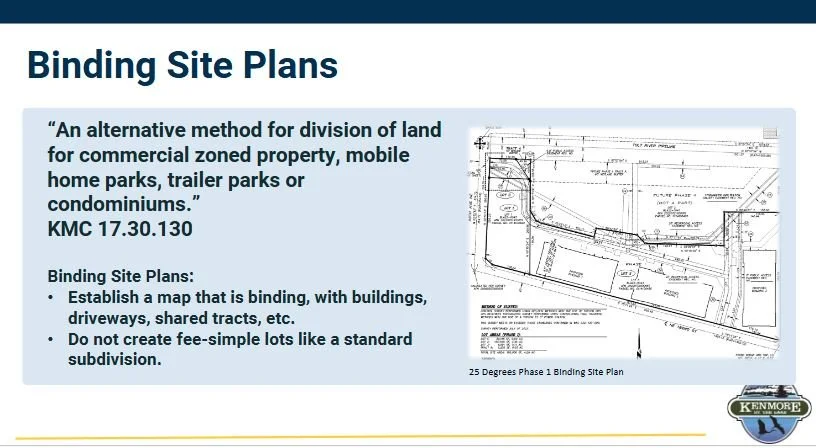
Reilly Rosbotham presented a proposed ordinance addressing binding site plans, common interest communities and permit timelines for consistency and conformance with State legislative updates.
Binding site plans establish the location of building footprints and drive aisles. The code change is clarifying that “commercial” development includes multi-family residential development. The code doesn’t currently prohibit it, so this is clarification.
Common interest communities (condominiums are one form), this clarifies that where you have two different ownership structures the City can’t impose additional restrictions if it uses the condominium form of ownership. Again, this is a clarification.
State law reduces permit time limitations for the City to review permits.
CM Marshall asked if staff believes they can tackle the new deadlines. They do.
Mayor Herbig opened the public hearing. Nobody signed in. The public hearing was closed.
BUSINESS AGENDA
BALLOT INITIATIVES
Initiatives that will be on the ballot this November in the general election. The public was invited to comment on each initiative. No public commenters were present, and council unanimously passed resolutions in opposition to each initiative.
IP 26-645: State and local taxes, repeals the 9.9% tax on individual annual income over $1m.
IL 26-001: Parental rights relating to children in public school. Repeals amendments and reenacts the law as it was originally enacted by I-2081.
IL 26-638: Restricts students who are biologically male from participating in girls sports.
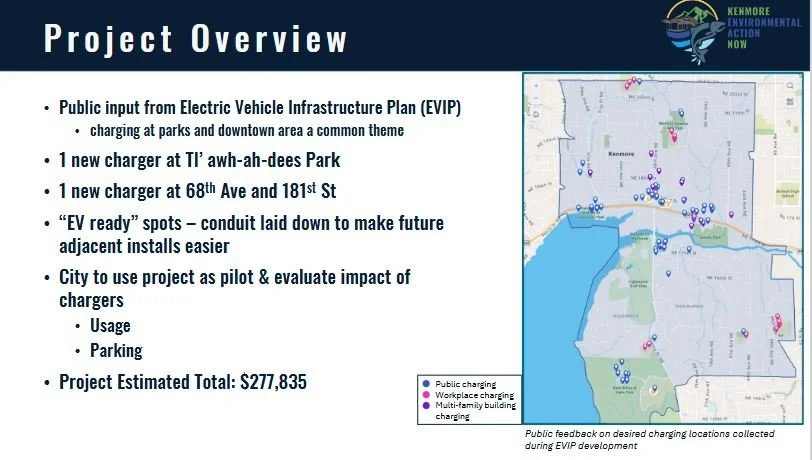
EV CHARGER INSTALLATION CONTRACT
Nina Rasmussen and Richard Sawyer presented. This contract installs two EV chargers at a cost of $277,835, including contingency and 5-year maintenance.. There are over 1,600 registered EV in Kenmore, and in the past 12 months 24% of new registrations in Kenmore were EVs. We outpace King County as a whole. Roughly 23% of our emissions are from vehicles.
CM Loutsis asked how much the city charges people to charge their cars, and mentioned that sometimes vandalism is an issue. They are working with the consultant to figure out what they can charge to cover the electric cost as well as some of the maintenance cost. Capital cost would be difficult to recoup because of the scale (only 2 chargers)..
DM Sasson said we should attach a purple air sensor to these.
Council passed a motion to approve this cost unanimously.
SALARY COMMISSION
Michelle Kang presented. There were 11 applicants; the mayor selected Derek Wycoff, Jeffrey Pooley, and Lynn Zwaagstra.
Motion to confirm appointments passed unanimously.
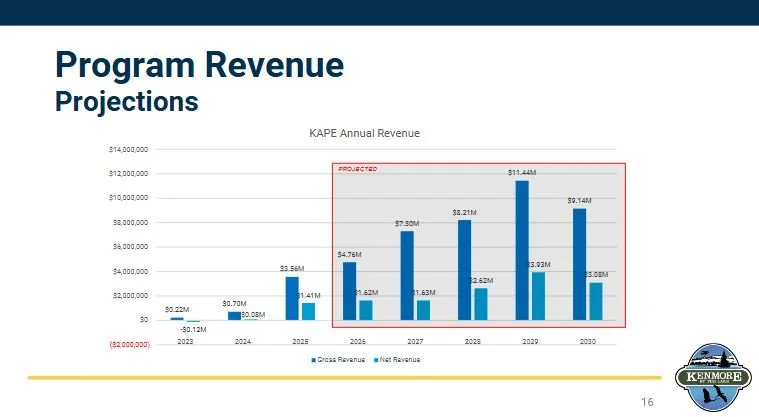
KAPE Update
Tobin overviewed the program history and a graph of the violations that we have seen. System-wide, the violation rate is less than 1%.
Debbie talked about court issues. The courts were backlogged initially, and have made changes to increase capacity and improve systems and are now caught up. Budgeting is difficult because we receive billing or the previous year in July of the following year.
John Vicente said that there were issues with the Inglemoor cameras: poor quality photos, power outage, cameras not capturing some violations, and delay in tickets. Staff is doing more monitoring of their own to make sure that they catch issues. Good forecasting on revenue and expenses requires a longer history of both to draw from than we have.
With previous years, our priorities for the revenue have been operating costs, traffic operations, pavement management, small works and general fund for police services. They would like to move the transfer to General Fund for Police services up to priority 3 (from 5). The legacy cameras (online before 2024) are not subject to revenue restrictions under state law. The new portable ones will have funds restricted under state law, however program costs are an eligible use for restricted funds. Because program costs exceed the restricted revenue, that will be paid out of restricted funds, and the net KAPE camera revenue will be unrestricted. Moving police services up in priority helps alleviate stress on the general fund. Teri Killgore added that pavement management and small projects are also eligible for other funding, where police are 100% general fund.
CM Culver moved to include a position for civilian review or the next budget. Motion died for lack of a second.
Mayor Herbig clarified that the money going to police time is time that we are already paying staff; it’s using the inbetween time. Staff confirmed this is the case, and if we reach the point where we need more time, then we would have a discussion about adding more staff or increasing the police contract.
CM Loutsis asked if there were any cameras operating at a deficit, and if there is a bottom floor for violations. He said there were some vandalism issues with Bellevue’s roll out of mobile cameras and we want to be mindful of that. Staff said that the only one operating at a loss is the red light camera ($39k/yr); from other long-term programs they don’t anticipate that happening to the rest of the system. Additionally, transportables are moved to where they are needed so they capture a higher number of violations.
DM Sasson thanked staff for a visionary safety effort. And asked when we are launching mobiles (new year).
Mayor Herbig would like to see us making more investment in engineering ourselves out of needing the cameras anymore. He said that 73rd southbound is running at 2x the amount of speeding as the rest of the system. Tobin said that 73rd is our highest rate but lowest volume. He thinks the violation rate in other areas is compressed by other traffic – you can’t speed if someone ahead of you is preventing it.
CM Culver wants the police on the streets instead of reviewing tickets.
COUNCILMEMBER REPORTS
CM O’Cain thanked Steve Yoder for bringing “pipe down” training to the city. She spoke about the importance of coming up with a “dark skies” lighting ordinance, and hopes to move forward with that in the next year. She’s looking forward to a time when our tax dollars don’t fund genocide and reckless wars.
CM Marshall thanked staff for their work and engagement on the Arrowhead traffic improvements.
CM Culver said Arrowhead’s speed cushion petition is now over 200, and Council should get engaged. Shout out McLemore.
Mayor Herbig said that the supreme court threw out Trump’s attempt to politicsize the USPS so our ballots can go through the mail still.
