
Park Impact Fees
I’m completely here for evidence-based decision making.
On Monday, July 20th, Councilmember Jon Culver removed Park Impact Fees (PIF) from the consent agenda for additional discussion, and to later move that Council adopt PIF at 80% instead of the previously agreed-upon 75%. His argument in favor of 80% contained a number of claims, referenced to The Urbanist, Department of Commerce, the American Planning Association, and median single-family home value, all of which deserve a deeper dive into source documents.
His first cited source was an article from The Urbanist, and CM Culver’s quotes come directly from that article. What he says is The Urbanist “countering some talking points” is, in the context of the article, just framing the debate and illustrating that there are at least two sides.
“Detractors think that they are designed to punish development and that the costs are passed through in the form of higher housing prices. However, professional planning opinion locally, nationally, and globally sits squarely in favor of impact fees as, quote, a fair way to fund additional services needed to the growth. “
CM Culver’s selection of quotes, and omission of the article’s text and paragraph break between, creates the implication that the second sentence (“However,...”) presents evidence that renders the first invalid. It doesn’t. In The Urbanist’s article, the first sentence is contained in the framing paragraph; the second begins a new paragraph, which presents additional framing from the planning community, before it goes on to cite an article on the relationship between impact fees and housing cost.
This is where the Urbanist’s article gets into trouble. The article says that “the economic research suggests that impact fees are a form of land value capture, causing lower land prices rather than higher housing costs.“ The source article, a 2004 study from Dade County, Florida, actually suggests impact fees do both:
“The results show that an additional US$1.00 of fees increases the price of both new and existing housing by about US$1.60 and reduces the price of land by about US$1.00. “
Although housing markets tend to be hyper-local, and Dade County c. 2004 is not the same building or regulatory environment as Kenmore c. 2026, the basic principles of housing economics are not something that change. Builders, as Housing Economist Logan Mohtashami likes to say, are not the March of Dimes. If the cost of making your product goes up and you can pass that increase on to the consumer, you do (higher housing cost). If you can’t, you look for ways to decrease cost in other areas (lower land acquisition cost). If the cost goes up so much that you can no longer make a profit, you stop producing (in the case of housing, this results in lower supply, and in turn higher housing cost for existing homes). Housing, governments often forget, is a commodity and a basic need; nobody is obligated to produce it, but lower supply doesn’t create lower demand.
The Dade County study isn’t the definitive source; nor does every study concur with their findings. A 2005 study out of Texas showed that impact fees increased land value as well:
“Results indicate that for each $1,000 increase in impact fees, lot values increase by 1.3 percent. Additionally, these results suggest that developers are able to pass a small amount of the impact fee to the owners of developable land. However, for undeveloped land the results are mixed. For each $1,000 in assessed impact fees, undeveloped land values decrease by 0.042 percent. These results support prior evidence that suggests home buyers may ultimately bear the majority of the cost of impact fees. “
Both of these studies, most importantly, concluded that the price of homes goes up in the presence of impact fees. The Dade County study concluded this is true for both new and existing homeowners. Setting aside his earlier implication that these fees are not passed along to homebuyers, CM Culver goes on to quote a Washington State Department of Commerce paper that states PIFs can lead not only to higher prices for new-home buyers, but higher values for existing residents as well:
“if homebuyers value new infrastructure investment as an amenity in terms of how much they are willing to pay for a home, as well as a reduction in what they would have paid in property taxes in the absence of the impact fee, home prices would indeed increase and potentially be more than the cost of the individual impact fees”
CM Culver quotes the Commerce paper as supporting inconclusive impact of these fees on the cost or volume of housing production, but what he left out is that the paper is quite clear, and consistent with the Dade County and Texas studies, that these fees are passed along to buyers:
“Some share of the impact fee is directly passed on to the buyer of the home in the form of higher home prices.” and “Impact fees verifiably lead to higher housing costs.”
This becomes problematic when he then goes on to argue that imposing higher PIFs are in lieu of increasing property taxes on existing residents. When new home prices increase, more buyers are forced to compete for the lower priced existing homes, which in turn raises the value of these homes. If the Commerce paper is correct and prices on new and existing homes increase simply because of improved parks the impact is layered; housing prices increase because of amenities and increased cost of new construction. As anyone who has paid property taxes in Kenmore knows, higher market value results in higher assessed value, and in turn higher property taxes. Although higher assessed value doesn’t increase the cost to purchase a home, it certainly increases your taxes, and your monthly cost of owning one.
Higher assessed value isn’t the only way that PIF will hit tax bills for existing Kenmore residents. Impact fees, including PIF, by design are only able to be used for growth and they statutorily cannot be used to maintain existing infrastructure. If a surge of development provides an influx of funds that allows the City to expand the parks capacity, the construction of the parks can be funded, at least in part, with impact fees. The maintenance, however, has to come out of the City’s budget. City Council has been discussing a ballot measure to create a Metropolitan Parks District (likely 2027 or 2028) to increase property taxes on existing homeowners and shift park-related expenditures out of the general fund to free up general fund monies for other obligations. It’s stunning in it’s simplicity, but the core principle behind the Strong Towns movement about why City budgets are failing was that we have decades of requiring developers to create infrastructure and didn’t plan for what it looks like to maintain said infrastructure. The bills for maintenance, repair and replacement are coming due, and we don’t have the funds to pay for our current obligations, let alone what maintenance would cost on an expanded network.
So, who pays? CM Culver closed his comments by saying that “new single-family construction is a median of $1.8 million!” and arguing that this requires income of $350-425k to purchase. CM Culver’s inference that purchasers of a $1.8m home could afford to pay more was clear, even if his math about the income required to qualify wasn’t. At 20% down and 6.5% interest, 30-year term, a household with an annual income of $261k could qualify – a smaller downpayment of 5% pushes the top-line income to $318k needed to qualify. This isn’t a modest income, but it’s not 270% of the Area Median Income (AMI).
Before asking for a second on his motion, CM Culver argued that PIFs are one of the few taxation tools that the State of Washington provides that are not regressive, and that we can “scale the fees for smaller developments.” RCW 82.02.060 requires that cities calculate their impact fee “based on the square footage, number of bedrooms, or trips generated, in the housing unit in order to produce a proportionally lower impact fee for smaller housing units” but offers no provision for calculating based on market value of the new residential unit created, unless the units qualify as low-income housing under the statute’s affordability exemption. If Council decided to waive or reduce PIFs for housing not dedicated as low-income, the city would have to cover the difference between the amount collected and the calculated impact by using public funds.
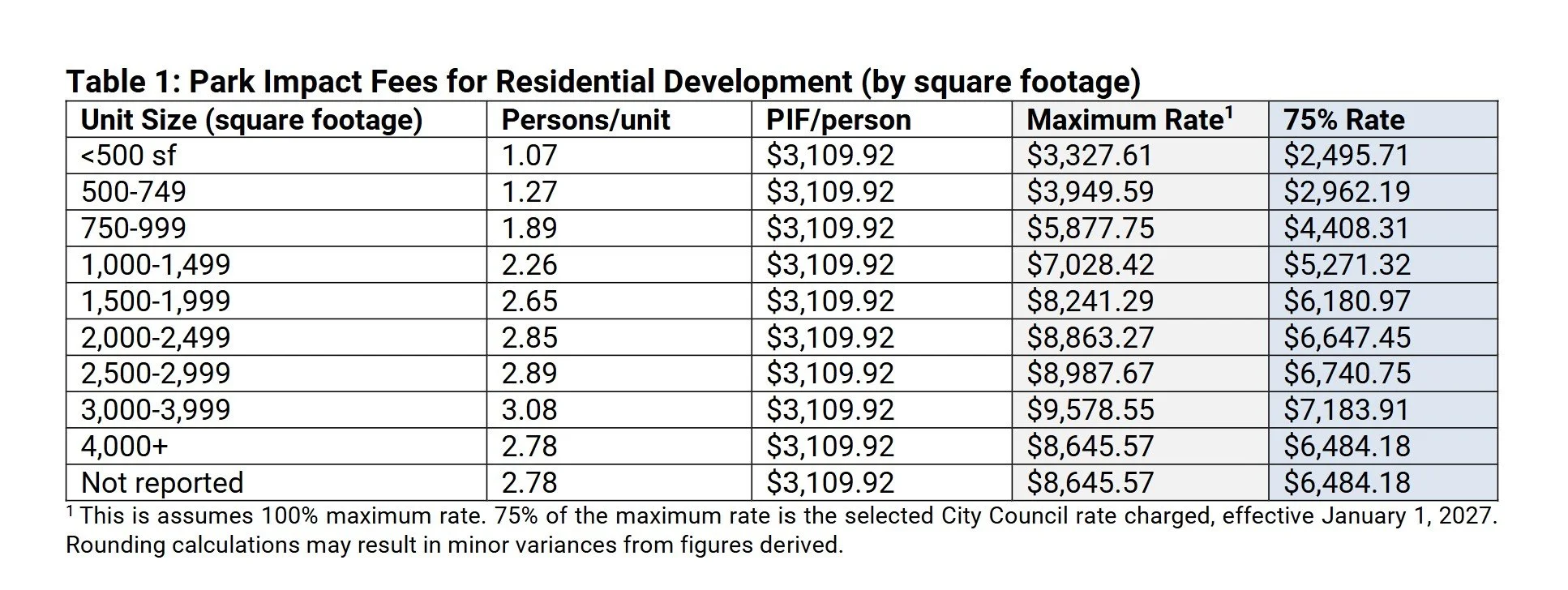
The table presented in Monday’s meeting packet detailed the PIF by square footage approach that City Council had previously chosen. As it currently stands, the fees are scaled; smaller units are assessed a lower PIF than larger units. What the table leaves off is the metric that the RCW won’t allow cities to base their fees on - the value of the home - which is exactly the comparison that reveals regressivity. Tax regressivity, in the simplest terms, is people with lower income paying a higher percentage of their income in taxes than people with higher incomes do. So, in order to determine if the PIF is regressive, we have to look at it in comparison to the value of the home (since a more expensive home requires a higher income to purchase).
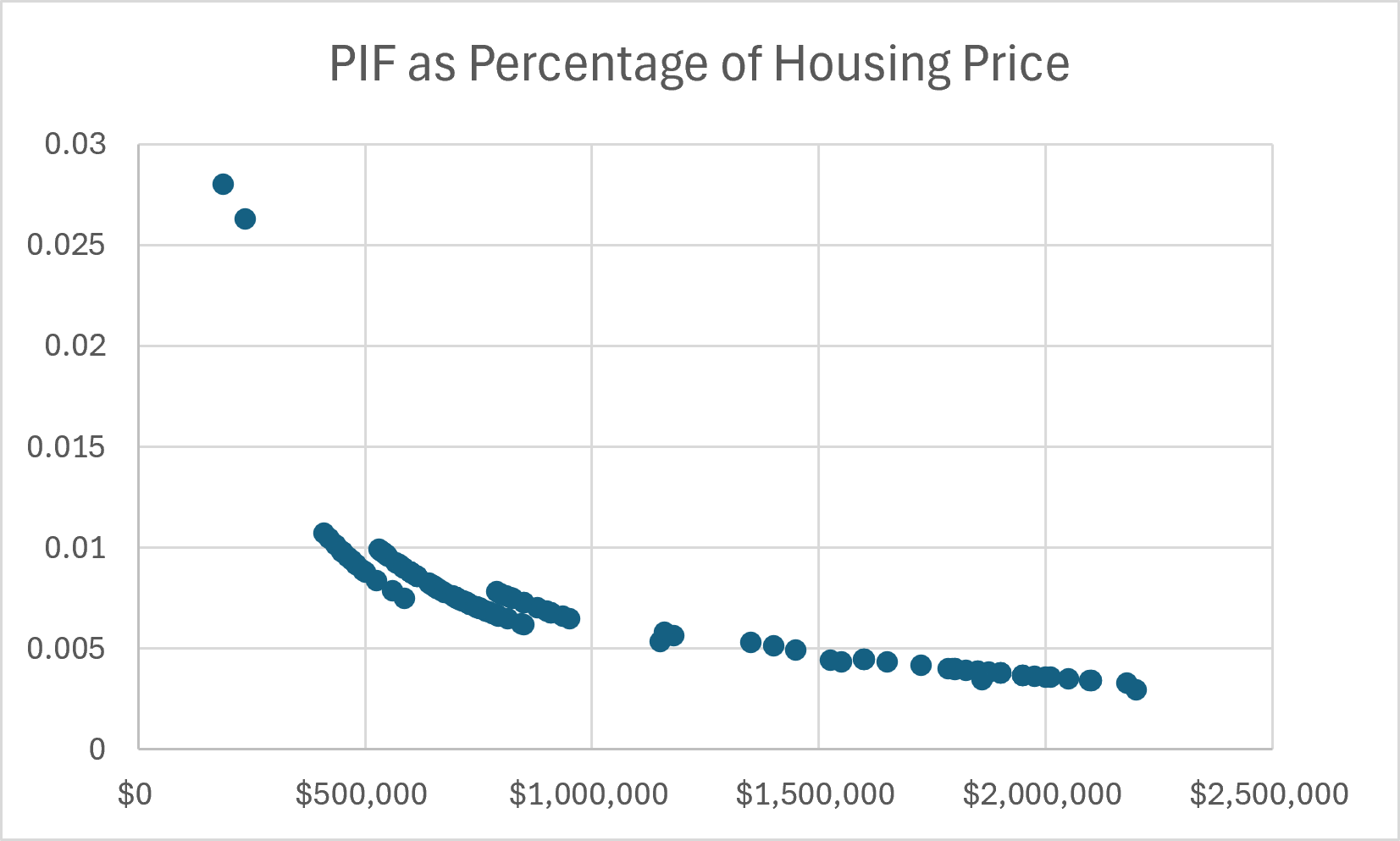
Taking the last two years of active, pending and sold new construction homes, and analyzing the potential PIF as a percentage of the sales price of the home, and graphing the results, it becomes abundantly clear that the higher the price of the home, the lower their PIF as a percentage of their home cost. In other words, the more money you have to buy a home, the lower the percentage of taxes you pay – the very definition of regressive taxation.
The bulk of residential new construction that hit the Kenmore market in the last two years was not, in fact, single-family homes. Seventy percent of new residences listed for sale were townhomes and condos – in other words, entry level homes and missing-middle housing. Where single-family homes only accounted for 28% of the new construction residences listed and sold, they made up the lion's share of the market value ($65m in the past two years vs. $63.3m for condos and townhomes combined) contributed more bedrooms (182 vs. 139 for condos and townhomes combined) and created a disproportionate share of square footage (125k total square feet vs. 128k for townhomes and condos combined) their contribution to PIF is substantially smaller. Using the buckets and amounts from Monday’s meeting, single-family homes would have contributed just $255k; townhomes and condos would have brought in $487k combined. Despite their larger size, higher price, and large number of bedrooms, because of how the square footage is bracketed in the methodology, single-family homes would have paid just $2.04 per square foot, vs $3.92 per square foot for condos. If the fees are being charged proportionately, its inverse proportion to the size of the residential unit.
If Council values evidence-based decision making when it comes to PIF, this has to start with an admission of what the evidence actually says. Impact fees both increase the cost of housing for new and existing residents, directly by raising the cost of housing, and indirectly by raising property taxes over the long-term. They are also regressive; without a State tool to tier or wave PIF on smaller units, our methodology is furthering a regressive taxation system. This isn’t a tool to tax the rich and leave everyone else unscathed - it’s a yet another way in which we’re making housing unaffordable, for the people who already have the most difficulty affording it.
CM Culver’s argument for 80%: https://youtu.be/WyL-yV3ixd4?t=1266
Urbanist Article: An Introduction to Impact Fees in Washington State » The Urbanist
Dade County Article: An empirical investigation of the effects of impact fees on housing and land markets - ScienceDirect
Texas Article: The Effect of Development Impact Fees on Land Values* - EVANS‐COWLEY - 2005 - Growth and Change - Wiley Online Library
Median Income Lookup: Area Median Income Lookup Tool
WA Department of Commerce; (NEED NEW COVER)
RCW Impact Fees: Chapter 82.02 RCW:
MRSC Impact Fees: MRSC - Impact Fees
