
September 2 Planning Commission Meeting
Cait’s Planning Commission Corner - 9-1-26
Community Development and Development Services have merged under the new Community Development Department; Debbie Bent has taken the position of Deputy City Manager, and Sam Loyuk will be the head of the new department, and will be the staff person assigned to the Planning Commission.
HOUSING STRATEGY PLAN
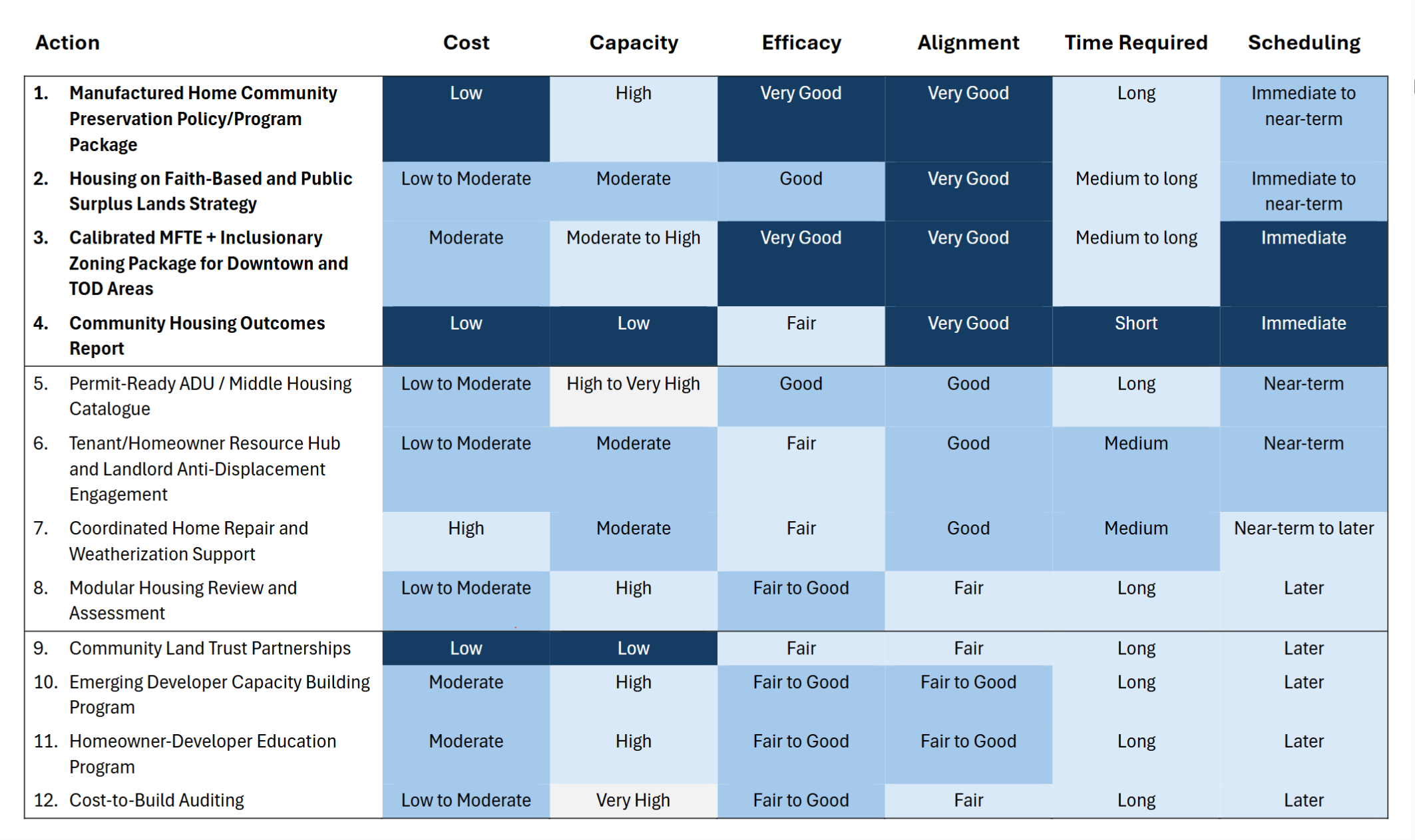
The objective of the meeting was to finalize the HSP in anticipation of an upcoming hearing in early October. Todd gave a brief review of the work that PC has done so far, including the four top priorities of Manufactured Home Community Preservation, Faith-based/Surplus Land, Multi-family tax exemption (MFTE) / inclusionary zoning and the community housing outcomes report.
C. Vanderlinde expressed concern that each action required funding and that we may have changes during the next legislative session. He noted that market forces won’t address deeply affordable housing, and we need policies that counter the market forces. If he could add anything to the list, it would be community land trust. We can't meet the City’s economic or development goals if we just focus on one section of housing; we need to have a diversity. He wants to know where the accountability is and who owns this plan going into the future.
VC. Dorrian said that we haven’t looked at barriers to production, and that some of the outputs stated don’t have associated activities that would lead to them. He doesn’t want to let perfect be the enemy of the good. He questioned whether what we are doing here is going to be enough if we’re behind in our development goals. Our housing plan is much more modest than other cities, and he wonders if we’re doing the right targeted things. He wants to make sure we’re moving the needle because we’ve had some missteps.
Debbie reminded commissioners that the City is not responsible for building housing; they are responsible for planning for housing to be built.
C. Macias said that she is good with the four priorities. She asked about revisiting how we are looking at high displacement risk [Andrew from ARCH said that the primary look would be at anti-displacement policies for manufactured home communities]. In response to other commissioners’ request for metrics, she pointed out that the “community outcomes report” is exactly what they are asking for, and we do have growth management targets as well. As an example, she noted we have had MFTE since 2019 and there’s already a trend line we can see. In her experience, with a development background, people like consistency on where and what they can build.
C. Lassalle also agrees with the four priorities. Kenmore needs to create more than maintain its park of affordable houses, and he wants to make sure that the city invests in the creation of housing. The invisible hand of the market doesn’t necessarily fix deeply affordable housing - whatever they recommend here is highly unlikely to address it. If the city doesn’t get its hands dirty, he doesn’t see how it will be built, so the plan needs to factor in what the City needs to actively pursue. He would like to see performance and activity trackers, for example units by level of affordability, number of manufactured homes, and also how many conversations people have had about developing faith-based lands, for example.
C. Thompson has concerns about what made it to the top four. He thinks homeowner education programs could be moved up, since a lot of our homeowners don’t understand how missing middle, and neighborhood commercial, work. He doesn’t want developers to see the Commission as trying to freeze them out. He asked why the permit-ready ADUs and permit-ready catalog, which can be implemented on the shorter timeframe, isn’t at the top of the list. This is something we could show the middle-income folks that the city cares about them, and their children and their parents. If we have metrics and targets, he wants to understand the barriers that are preventing us from meeting them. He wants a mandatory review of the plan every two years. He wants the commission to have six months to come back with suggested metrics to track.
Chair Banaszynski asked about the priority of how the items were laid out. She is “fine” with permit ready ADU catalogs in phase 2 but wouldn’t mind it moving to phase 3. She is concerned the uptake isn’t enough for the cost. If that moved down, she’d like community land trusts to move up. She would like to see the outcomes associated with metrics and targets. She asked Andrew about the dashboard and reporting metrics and emphasized how important it is for people to be securely housed. She wants a date put to the things on the plan so she can see when staff thinks they are going to be done. She wants to plan something that will get housing built. She wants to track metrics even if it’s permits and not necessarily units in the ground because she wants the city to be accountable for this.
Andrew from ARCH talked about his aversion to dashboards since they can go obsolete very quickly. Commerce requires that we take good-faith measures to reduce obstacles and ensure that there is enough land available. By 2029, if there’s not good activity in STEP housing for example, this would be an opportunity to look again and reposition if necessary. A lot of housing action plans include things that cities will never touch for a variety of reasons - the reason to hone in on things is to determine where to focus. He said that the permit-ready ADUs would produce housing faster than a lot of other things on the list, but the number of units created is not immediately trackable in the short term because development, uptake and production still takes time.
Sam said that the pre-approved plan process would be a two-year program with some budget and then updating every three years as plans changed. She said other e-gov alliance cities have it and are seeing what works best. Andrew mentioned that other communities have a self-certification process for architects so they don’t have to go through the full permitting process.
Todd pointed out that if this plan has to be updated every year or two that is a heavy lift for staff.
At the next meeting, some students will join PC from the design contest for neighborhood retail. There are amendments to the capital facilities table that will come up next time, as well as a series of minor code amendments and map cleanup.
