
The City of Kenmore recently tried, and failed, to pass their first Levy Lid Lift. A quick look back at the history of how this measure ended up on the November 3rd ballot gives insight both into the dynamics of our City Council, and what they could have done to create a successful measure.
At the May 2025 retreat, Staff introduced three options for ballot measures: Metropolitan Parks District (MPD), Public Safety, or Public Safety + Human Services. Staff had done their research; as early as the retreat, surveys were presented that showed the MPD with a 54% approval rating. The three options presented echoed former CM Srebnik’s desire for whatever ballot measure that they put forward to be crystal-clear with voters. Voters have to know what they’re paying, and what they’re getting in return. The February 23rd, 2026 Council Meeting provided further data for council about where Kenmore voters priorities lie: maintaining public safety, roads and parks.
Early conversations, surveys, and good governance would indicate that the wise choice would have been either a Public Safety LLL or a Metropolitan Parks District. In a meeting last summer with interim City Manager Stephanie Lucash, she said that the City was looking at forming a MPD to fund parks. The MPD would be a “98028” Parks district (Kenmore only) and create a dedicated revenue for parks. Moving those funds out of the General Fund would address the structural deficit, and save us from the fiscal cliff.
Discussions of the levy lid lift (LLL) that became “Prop 1” started at the March 2026 City Council Retreat. The two options with the strongest indicators of support (Public Safety LLL and Metropolitan Parks District (MPD)) were presented by staff, with a third wildcard option: the “KenMORE 🖤” levy, which included housing, human services, climate and economic development.
From the outset, Council was split: CM Culver was a strong supporter of housing, human services, and climate, calling them “absolute bangers” and asserting that they have heard “loud and clear from the community that everyone cares about affordable housing.” DM Sasson expressed consistent support, saying that voters were fired up for 2026, and “taxation is how we finance care for one another.”
CM Loutsis was the most vocal opposition on council, with a strong preference for the MPD. CM Adman expressed consistent preference for the Public Safety LLL, since the connection between the budget deficit and increase in police services cost is easy to articulate. Mayor Herbig expressed reservations that the KenMORE 🖤 LLL did not address the underlying budget deficit, and the lack of time for community development (the consultants agreed with Mayor Herbig - 2026 was fast, leaving no time for community education). CMs Marshall and O’Cain were consistently opposed, citing affordability concerns for residents, and the need to take a deeper look at spending and cuts before asking the voters for money.
During the April 6th City Council Meeting, CM Culver presented a research brief in support of the KenMORE 🖤 and spent over six consecutive minutes making his pitch to Council about why his levy is the one that they should choose.. He opposed a MPD, since Lake Forest Park’s first attempt failed by just 30 votes (though it passed this November). He was so confident that the levy would pass, he ended his speech by saying that he would jump in the lake if it failed and Council could rub their “I told you so’s” in his face until the salmon come home .https://youtu.be/j3FHYH4VXko?t=2996
He continued his rally at the May 4th meeting, saying that Council is funding where we are right now, and he wants more – he wants “the moon.” He was unconcerned about community engagement, because they’d heard a bit from groups who wrote in support; NUHSA, PERK, Northshore Social Justice Action Group (of which he’s a founding member) and the Climate Action Committee. CM Adman recommended a 6-year levy, DM Sasson agreed, and said Council should not consider a temporary measure.
The ordinance authorizing the ballot measure was passed on June 15, 2026 with CM O’Cain opposed (CM Marshall absent for his son’s graduation) and continuing to call for budget cuts. On November 3rd, the measure failed spectacularly, earning only a measly 33% of the vote. In meetings since the election, CM Culver has called for a “Prop 1 debrief” to understand what went wrong, and has provided his own speculation while refusing to take accountability for his roll. He believes the fault lies in the “permanent” measure – which was suggested by CM Adman – because those have only a 40% track record of passing.
The truth is so much simpler, and a better path was outlined in the meetings: both a Public Safety LLL and an MPD had a better chance of passing. Pick one. Council needed to start with budget cuts, address the underlying structural deficit, and give voters a clear understanding of the cost and results (which both Public Safety and MPD do). The City needed time for education and outreach - which a five month turnaround didn’t leave. The fatal flaw in Prop, 1 was CM Culver, and his unrelenting advocacy for ballot measure that didn’t reflect what the vast majority of Kenmore voters wanted, combined with his inability to listen to, and work with, his fellow Councilmembers.
KenMORE🖤’s “Progressive Priorities” & Regressive Taxation
In the April 6th meeting, CM Culver said that housing, climate and human services are “absolute bangers at the ballot box.” These progressive priorities, aimed at addressing inequality and preserving the climate, are worthy causes when you have the money to support them. The problem is that they’re being funded with a regressive tax which is increasing the cost of housing across the board - regardless of someone’s ability to afford it.
CM Culver and the “Yes on Prop 1” routinely claimed that qualified seniors and veterans would be exempt, but those exemptions were nowhere close to extensive enough to encompass every person who would be adversely impacted by rising property taxes.
The exemptions left out renters, whose rents will likely increase due to the landlord’s rising costs, and anyone low-income under the age of 61, or anyone over the age of 61 with a combined household income just a dollar over the threshold needed to receive a property tax break ($88,998/yr in 2025). Substantial income changes can hit households in many ways - divorce, death of a spouse, birth of a child, change in job, or disability, just to name a few - and strap household budgets for those who don’t qualify for exemption.
It’s also the case for most residents that the value of their home is not what it was when they purchased it, and in many cases, their home value has grown at a faster rate than their incomes. This means that the taxes, too, have increased over time, and when incomes don’t keep up (and everything else gets more expensive) it gets harder and harder to find an extra $30/mo to contribute to someone else’s affordable housing or subsidize their EV charger.
Of course, there are those who could afford the extra $30/mo but recognized the regressivity. A “yes” vote on Prop 1 not only obligated you and your richest friends to pay it, but also the people in our community who would have to start making difficult tradeoffs to find the extra funds. When your neighbors start moving out of Kenmore because the taxes are so high, it’s hard to not think twice.
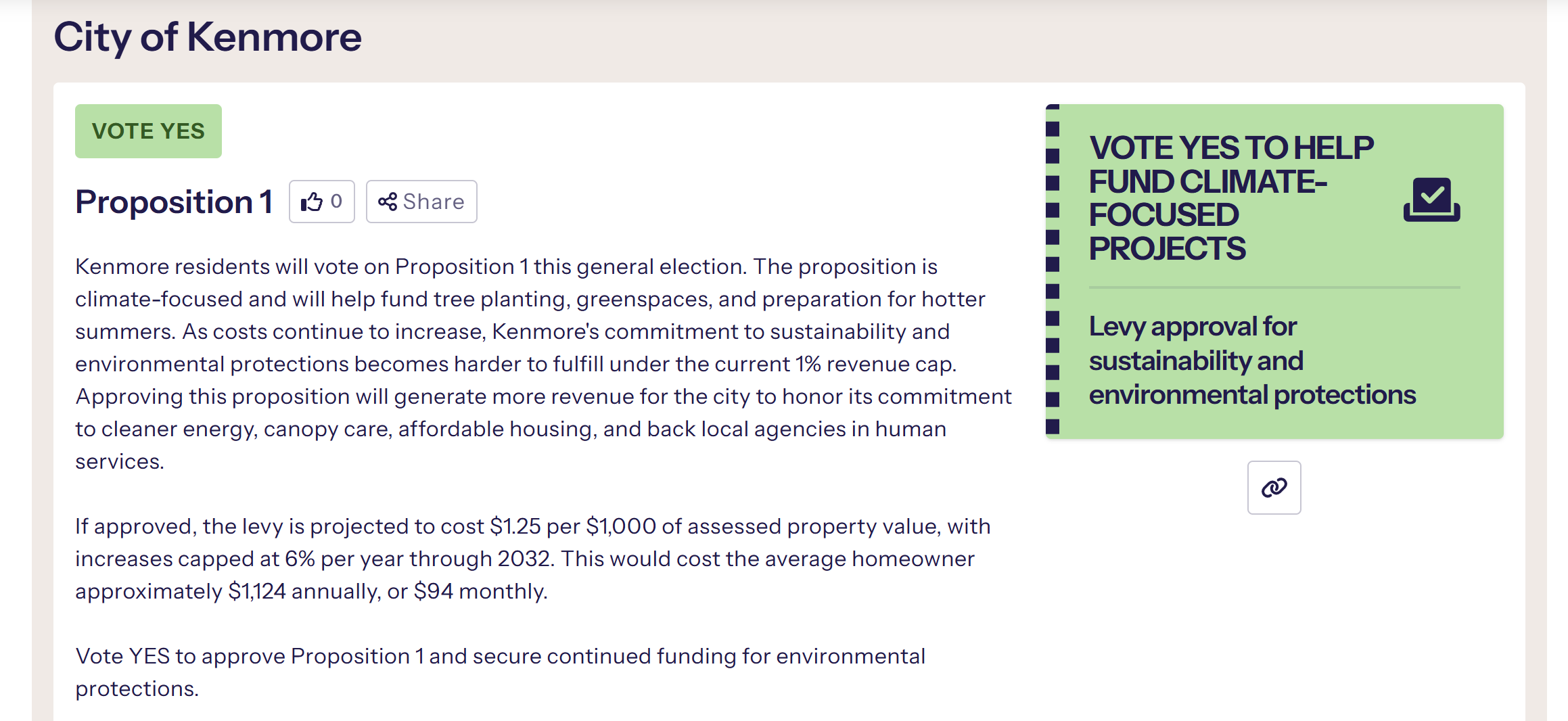
Cost and Impact of the KenMORE🖤: Clear as mud
Property taxes are confusing, and property tax levies are confusing, and it’s clear that City Council wasn’t any clearer on this than the voting public. The information presented by Staff in the Council meetings never explained what the ‘limit factor” was and how that would change revenue and property taxes in years 2-6 of the levy. If City Staff had been given more time to research and educate themselves, council, and voters on how LLLs work, they certainly could have come up with a ballot measure that reflected their intent and goals.
The City’s stated intent, as they later had to pass a resolution to clarify, was to increase their levy by $3.3m in the first year and then add 1% per year for each subsequent year. This is a one year, permanent, levy lid lift and would have required a rate of $1.16 per $1k of assessed value (based on 2027 assessed values). What they put on the ballot was a rate of $1.25/$1k of assessed value, and the ordinance authorizing it said that Council SHALL levy that rate if the measure passes, increasing by up to 6% per year for six years, and then becoming permanent thereafter. If you’re able to do the math on the average $1m Kenmore home, the impact ends up being much more than $30/mo with a 1% increase, and dramatically increasing the City’s spending on climate, housing and human services.
To make matters even weirder, the “Yes on Prop 1” committee put their messaging at $29/mo for the average homeowner – $1/mo under the City’s own estimate. The Progressive Voter’s Guide endorsement said that the cost would be $94/mo, or $1,124 annually for the average homeowner. When even the supporters couldn’t agree on what the cost would be, it became very hard for anyone paying even peripheral attention to know who or what to trust.
Just as unclear as the cost was the messaging around what this would fund - vague buckets of housing, climate and human services (which, see above, was a departure from the original plan that included economic development) with no restrictions on how funds would be shifted between. The current level of spending in these three buckets was just over $2m, but the levy proposed a 50% increase so that costs could be shifted from the General Fund where they fit into these categories.
Had Prop 1 passed and the City had levied $1.25 per $1m of assessed value (2027 rate was just passed by Council at .78), with the 6% annual increase, we can't rule out the possibility that the City would just dramatically increase spending in these three categories. During the October 26, 2026 meeting CM Culver alluded to using the money from Prop 1 to fund the acquisition and restoration of parcels along Swamp Creek in the TOD (https://youtu.be/-bCnCrcQTM8?t=12045). The way that the ballot levy was written, everything raised could have been used by the City to purchase more land. There’s roughly $35m of land in the TOD near Swamp Creek, and over the next decade the ballot measure could have funded the purchase of that entire area.
With enough voters feeling the pressure of increasingly precarious financial situations, it’s hard to want to opt in to paying more when what you’re getting in return isn’t clear. Prop 1 had no defined outcomes, goals, or metrics for success. It wasn’t funding an essential service; it looked a lot more like giving the City of Kenmore the authorization to make charitable contributions on your behalf. Since a charitable contribution is something people do when they have money to spare, a lot of voters opted out. With clearer messaging, earlier voter engagement, and more time to solidify their own ideas on what this measure would fund, it’s possible that the City could have created a winning ballot measure. Instead, Council will be looking at budget cuts in 2027, and voters should be anticipating another LLL to make an appearance on an upcoming ballot.
