
Property Taxes Made Simple
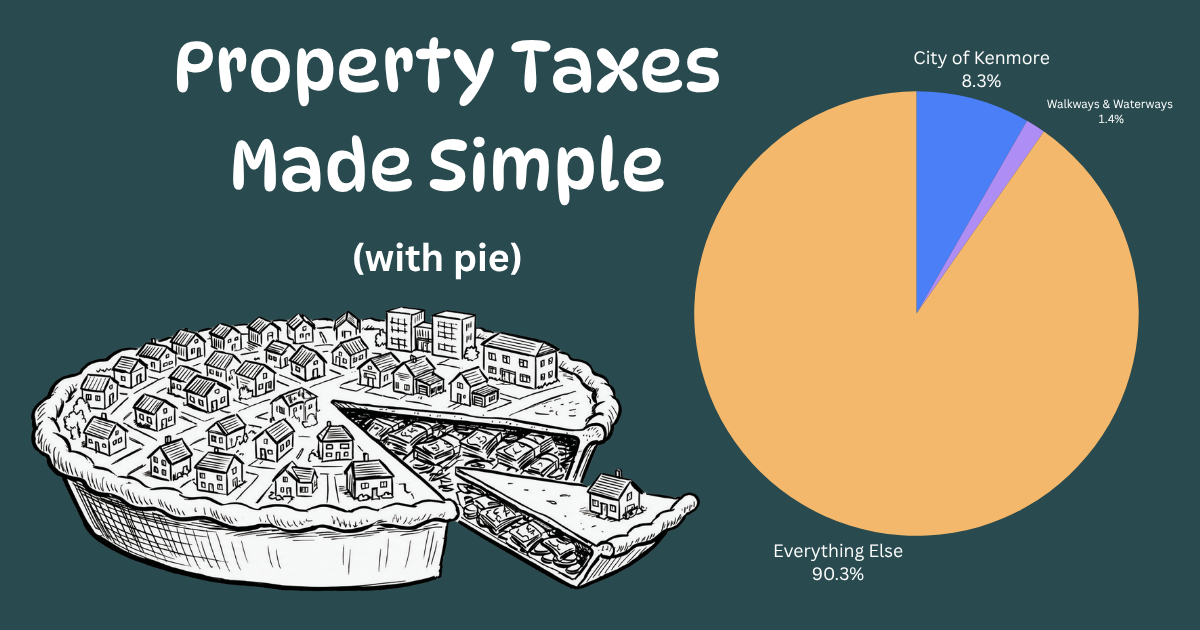
As ballots arrive, voters will be asked to make a decision on Kenmore’s first ever Levy Lid Lift (LLL), Proposition 1, and it’s worth knowing exactly how this will impact your tax bill. Property tax in Washington is not a straightforward percentage on the value of your property, but a more indirect calculation where property owners effectively pay for their “slice of the pie.” When we understand how property taxes work, it’s easier to see the accurate impact of Proposition 1.
Property Taxes Simplified
The easiest way to think about property taxes is to think about it in terms of two “pies”. The first pie is the assessed value pie. This is made by adding up the assessed fair market value of every property in the City. Your property makes up a tiny slice of this value pie. The percentage of the pie that your property makes up is actually what determines how much you’ll pay in taxes to the City each year. The City of Kenmore’s “pie” is approximately $9.17B, so the $1M home that they use as an example is just over .01%.
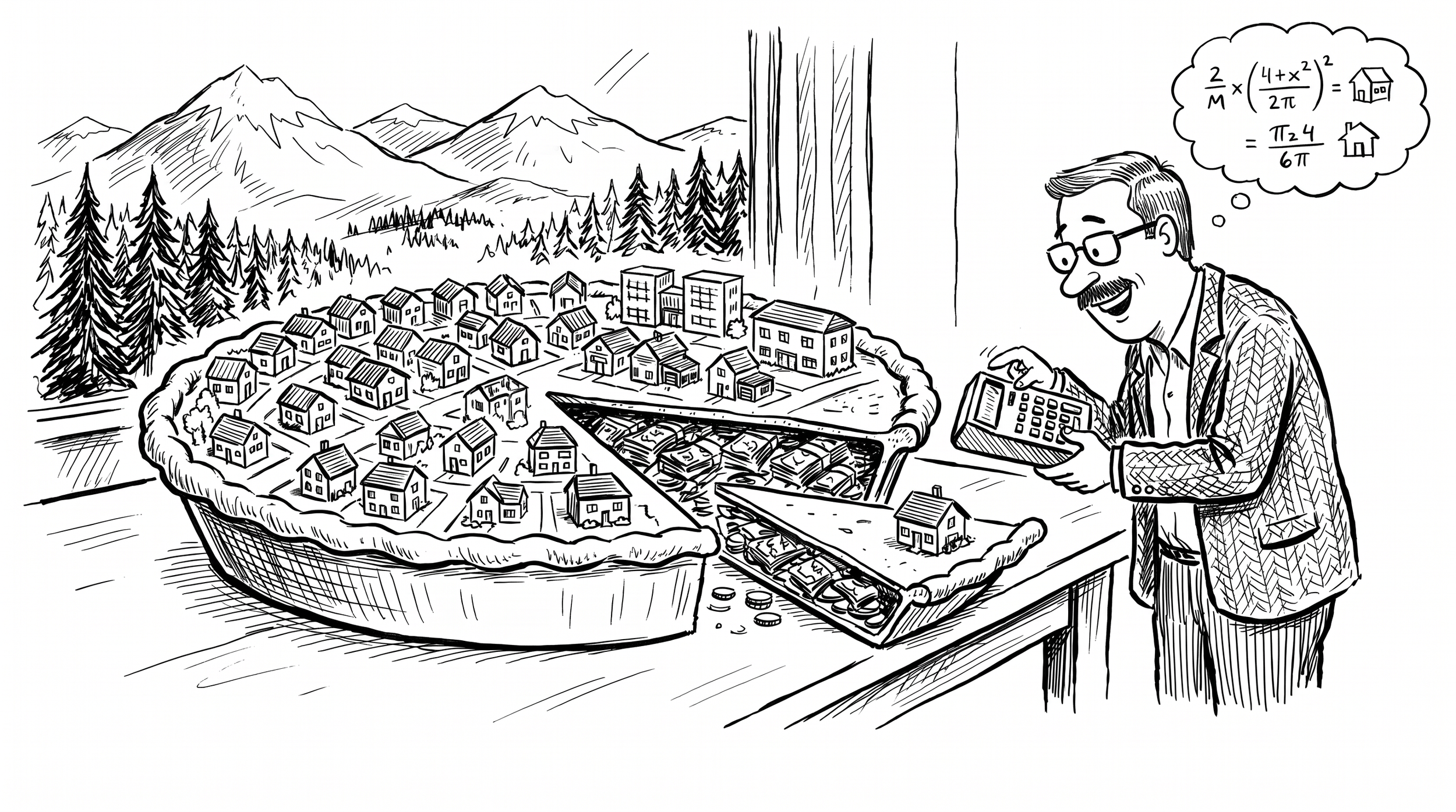
The second “pie” is the levy pie. A “levy” is how much tax the City is authorized to collect from taxpayers; because these taxes are collected via property tax, the taxes are distributed among property owners in the City. Each property owner is responsible for paying the percentage of the budget that is equivalent to their slice of the assessed value pie. The owner of the example $1M home pays .01% of the City’s levy.
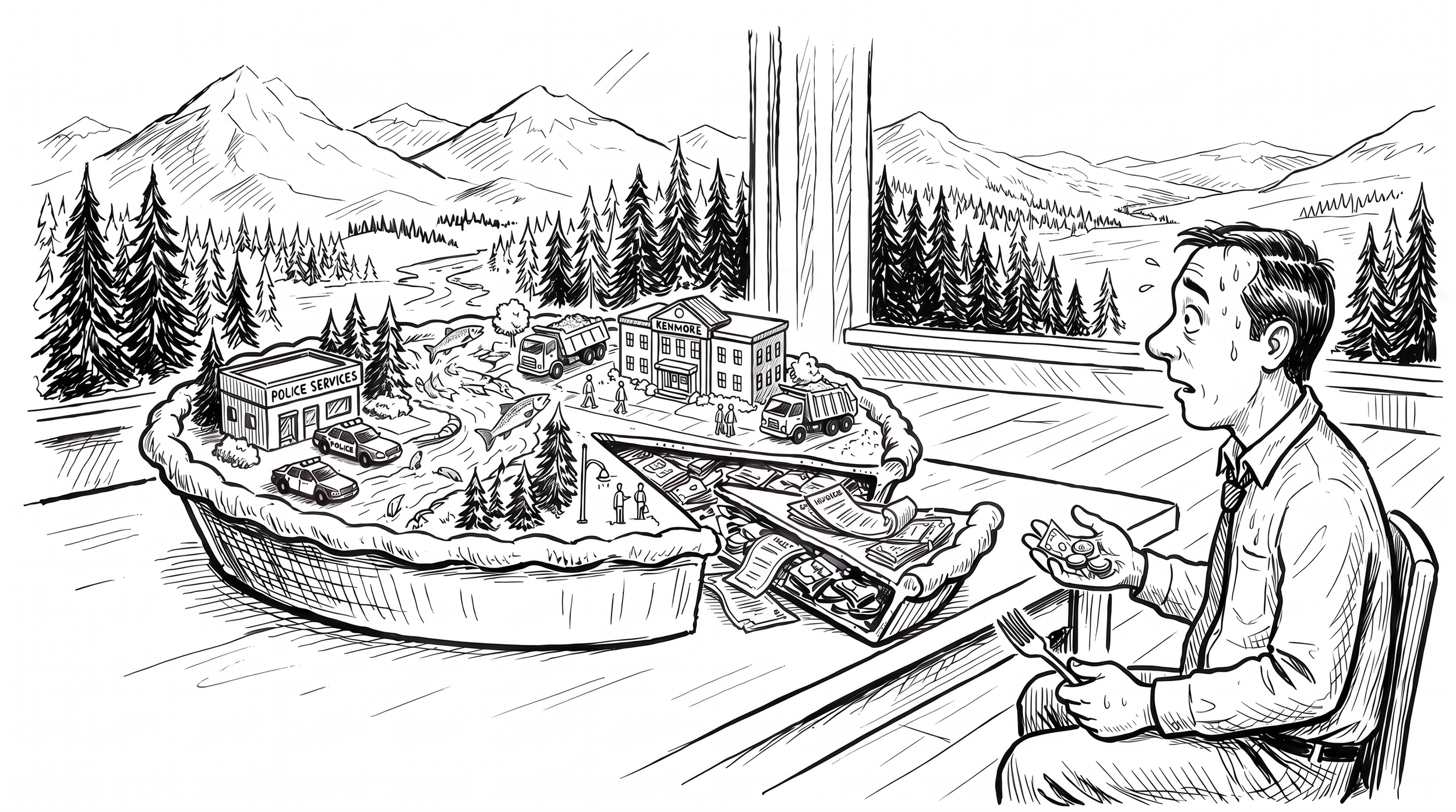
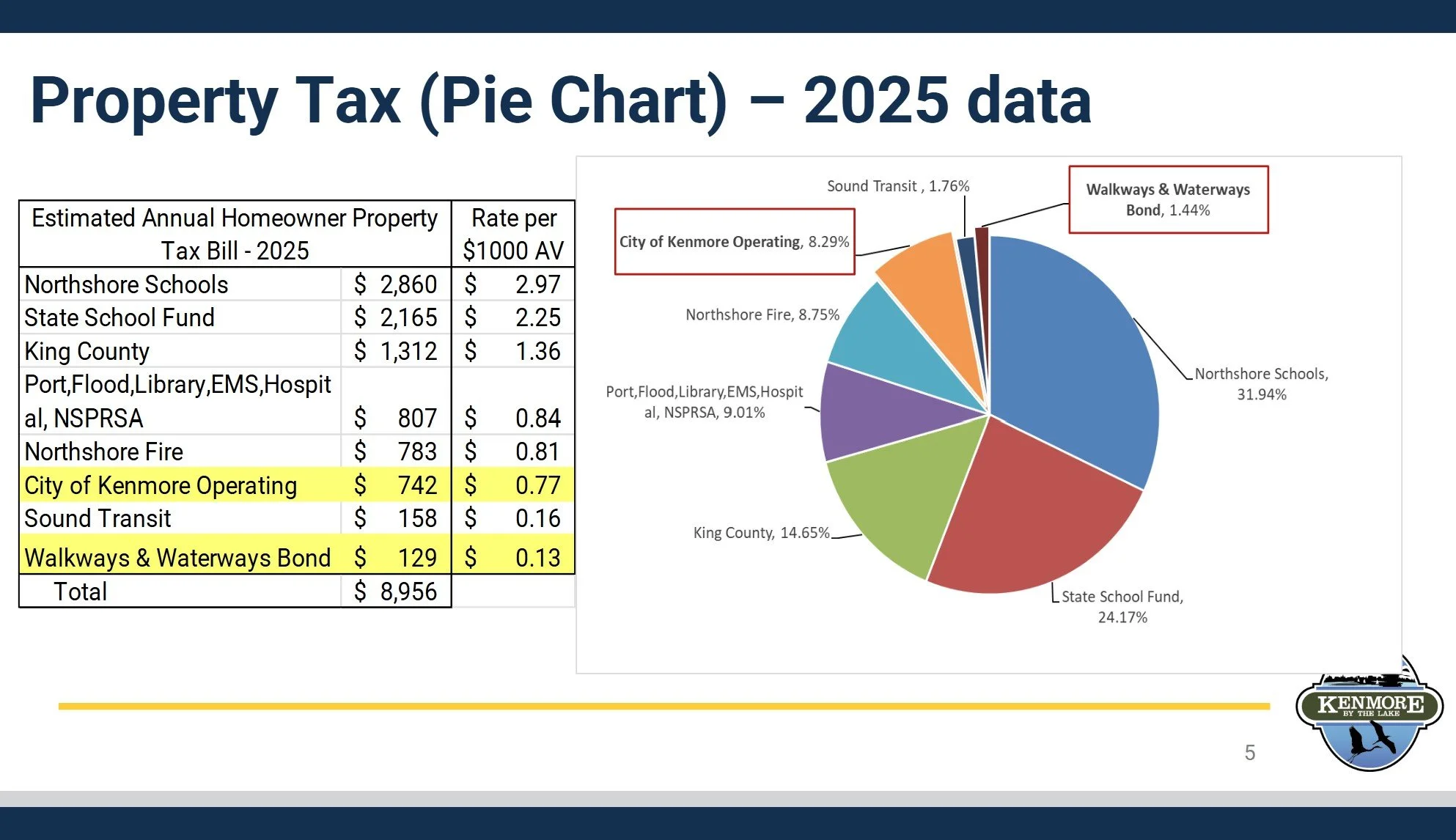
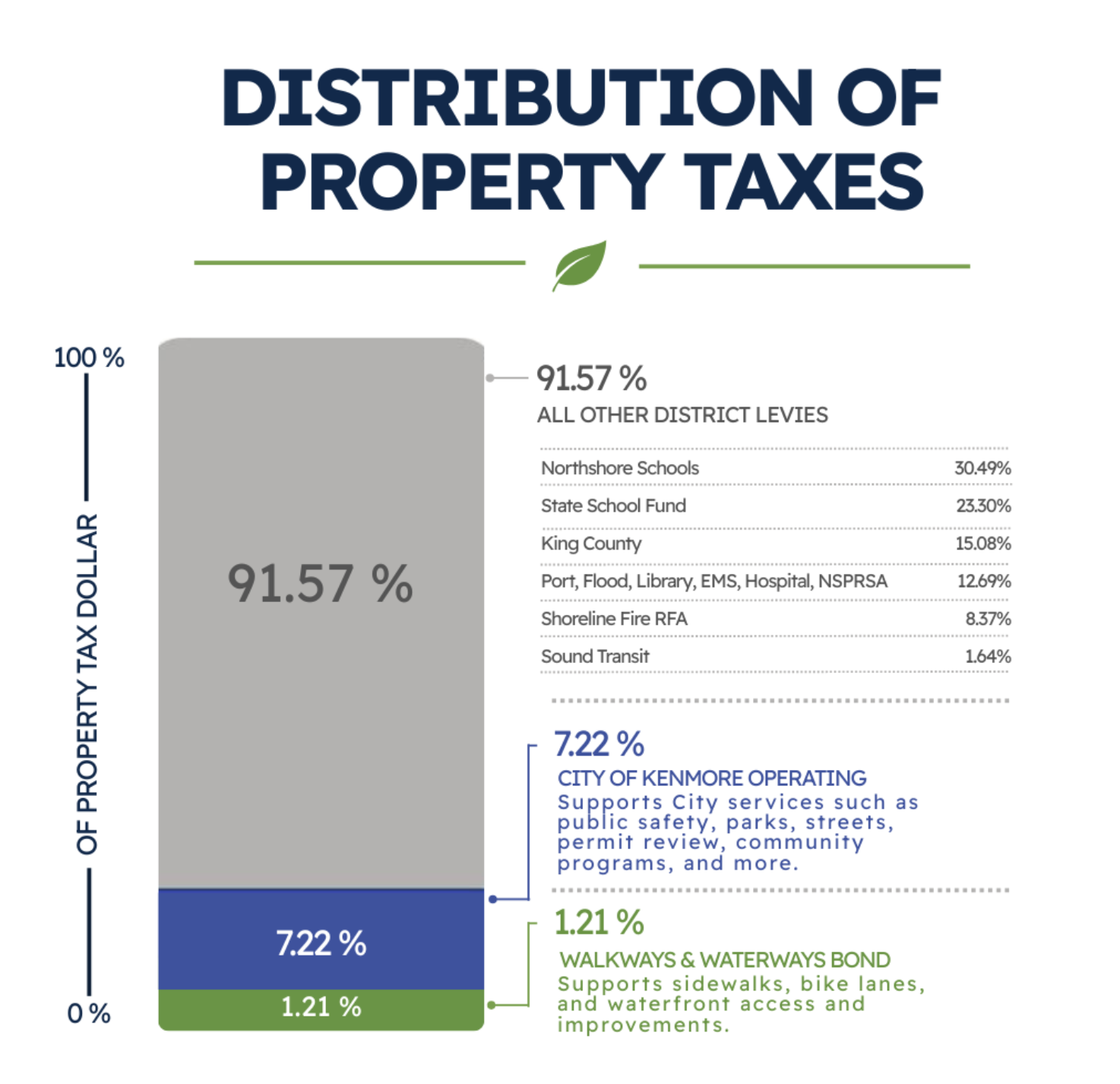
There’s one more pie that taxpayers are probably most familiar with; your property tax pie chart. The City is not the only taxing district to receive funds from your property taxes. There are other taxing districts with their own levies, such as fire, EMS, hospitals and schools. Each submits their levy request to the assessor, who determines how much they can collect in total. Some of these taxing districts (for example, Northshore School District) span multiple cities, so their assessed value pie would be different, but the principle stays the same.
Once the assessor’s office determines the size of your levy slice from each taxing district, those are added up to become your property tax bill. This is a very colorful pie with slices of all different sizes, each representing the percentage of your total taxes that go to each taxing district. There’s a little something for everyone in your property tax pie.
Why are our rates expressed in dollars/cents per thousand dollars? It’s because the Assessor does one extra step of math. Instead of making your property a straight percentage in the first pie, they divide the pie into $1k slices, then divide the levy pie into the same number of slices. The number of levy slices you’re responsible for is the same number of $1k slices in the first pie it would take to make up the value of your house. The math works out the same.
What’s a “Levy Lid Lift”?
When the County Assessor processes the levy requests, they have to take into account if there are any “lids” (caps) on the levies which restrict the amount of year-over-year increase in funds that a taxing district can receive. Back in 2001, Tim Eyman sponsored an initiative that capped the City’s levy (total property tax collection) growth to 1% per year. This 1% cap creates what is often referred to as a “structural deficit” – the way our tax code is configured means property tax revenue cannot keep up with rising expenses and inflation when total collection cannot increase more than 1% per year.
The built-in exception to this 1% growth is when new construction is added; then the levy pie is allowed to grow above 1% (adding new construction makes the assessed value pie bigger, so your proportionate slice is smaller, so you’d be paying a smaller percentage of the City levy even when the levy grows in the case of new construction). If the City wants to grow their levy pie more than 1% per year, not taking new construction into account, they need to ask the voters for a “levy lid lift” to lift this 1% cap. That’s what Proposition 1 is.
Proposition 1
Prop. 1 asks the voters to approve a six-year, permanent, levy lid lift. The City’s documents show that they want to increase their levy by $3,300,000 in year 1 of the levy. Based on 2026 tax rates of $.70 per $1k of property value (or $700 for a $1M home) this would be the equivalent of a $.36/$1k increase, bringing the total collection up to $1.06 per $1k in property value, or $1,060 per year for the regular property taxes to the City of Kenmore (Walkways and Waterways is extra).
This extra $.36 is the math if next year we have the same size assessed value pie, and the same number of $1k slices, as we do this year (which is how the City is coming up with their estimate on your tax increase). Property values have been declining, though, and are expected to continue for the near future, so the assessed value pie next year may well be smaller. This means that when the County splits it into $1k slices, there will be fewer. When the levy pie gets split into the equivalent number of slices, each is bigger. But, because your individual property value will have declined, you’re responsible for fewer slices.
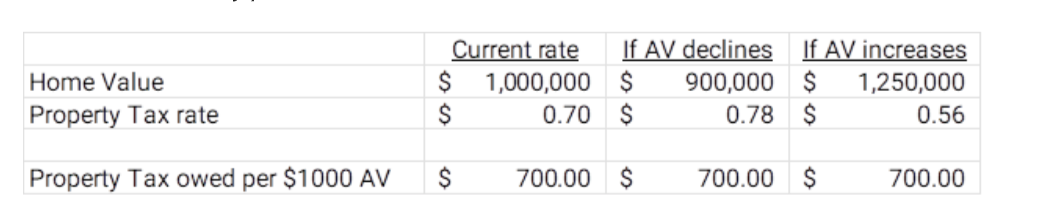
The total dollar amount that you’re paying the City will stay relatively stable, but the rate will go up if the assessed value declines (larger levy pie pieces, you get fewer of them), and will go down if the assessed value increases (smaller levy pie pieces, you get more of them).
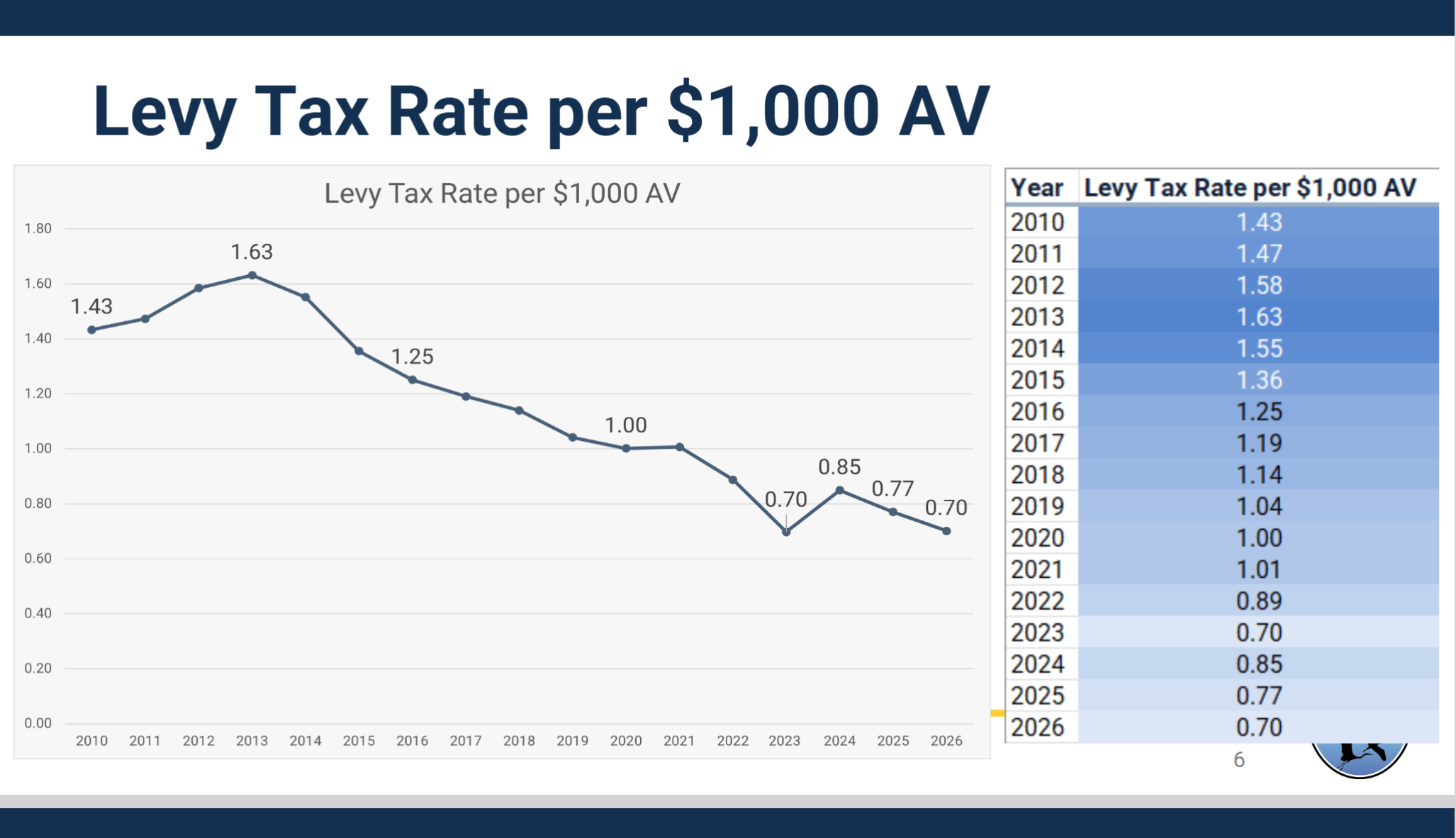
The graph below shows that as property values have increased, the levy rate per $1k has decreased.
The City isn’t just capped on the growth of the levy; they’re also capped on the total dollars per thousand that they can collect from property taxes. This is why Prop. 1 says that it will increase the regular maximum levy rate to $1.25 and then authorize a 6% increase for the duration of the levy. The City’s goal is a $3,300,000 collection in year one, then increased 1% in the next five years of the levy, reaching $3,468,333. However, since the tax per $1k number goes up as property values decline, in order to keep total collections stable, they may find themselves needing to raise the total tax per $1k above what is currently allowed.
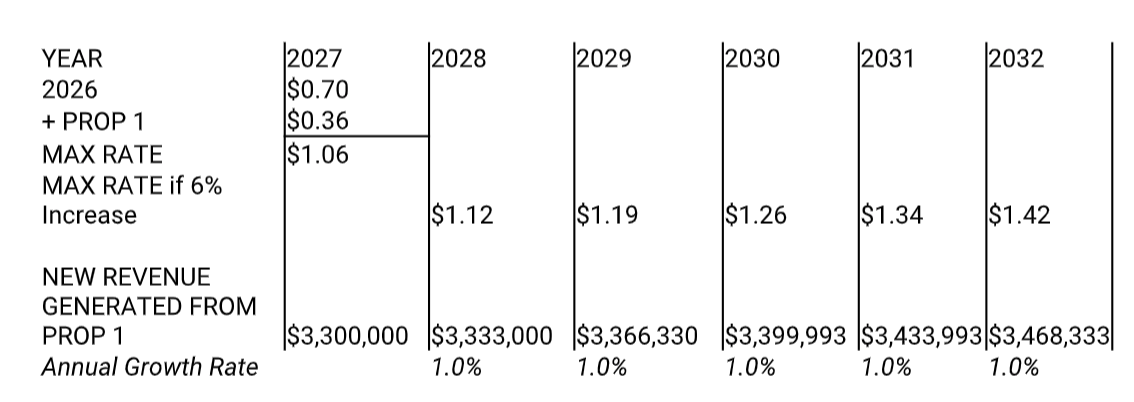
To be very clear: where you could see that your tax rate on your bill from the City is $1.42 per $1k of value by 2032, that would only be the case if property values dropped dramatically (over 20%). Going back to the pies: if property values decline proportionately, then your slice of the assessed value pie stays the same. When your slice of the assessed value pie stays the same, your slice of the levy pie also stays the same. That’s the ratio that determines the total dollar amount in taxes you pay, not the tax bill math of dollars per $1k.
The “six year, permanent” portion of the proposition means the size of the City’s levy at the end of the six years becomes the new basis for the 1% increase. Basically, we get a one-time adjustment of roughly 51% increase in total taxes paid, which then grows at 1% a year as it otherwise would.
I’m still confused
The burning question for everyone is: how much will this raise my taxes? Because your “City” portion on your tax bill includes Walkways & Waterways as well as the general fund, calculating the increase is easiest. And, as confusing as it is, we are now going to look at $1k in value.
Take your current assessed value, divide it by $1,000. Then multiply by $0.30. That’s your first year increase. Five years of 1% increases on top of that is just over a 5% increase (because, compounding), so to get the total at the end of year five, multiply by 1.051. That’s it. That’s the increase.
$1m home (assessed value this year) year one: $360.
$1m home (assessed value 2026) year six: $378.36
The City of Kenmore has a calculator where you can estimate your tax increase, as well as answers to FAQ on their website: Proposition 1: Climate & Environmental Stewardship, Affordable Housing, and Human Services Levy | City of Kenmore Washington
