
Sept 21 City Council Meeting

Prior to the regular meeting, Council entered into Executive Session. Following the session, Council voted 6-1 (CM Culver opposed) to authorize the City Attorney’s office to file a lawsuit to enforce a Hearings Examiner’s ruling regarding a resident who removed two exceptional trees in an environmentally critical area (ECA) without a permit. The Hearings Examiner’s decision required the resident to get a permit, and complete the requirements, including planting 45 replacement trees, by October 2025.
WHERE’S THE FUN
Oktoberfest!
PUBLIC COMMENT
Ten people showed up to comment about speed humps at Arrowhead, Asphalt plant, streams and Prop 1.
Planning Commission Chair Banaszynski commented on the TOD parcel amendments. She reminded Council that the TOD interim regulations were in response to a minority report she wrote in November 2022. She thought that the TOD regulations would allow inappropriately dense development and fail to protect Swamp Creek or would get in the way of future “meaningful” opportunities for restoration. She said Staff had not addressed her concerns, and asked that this issue not move forward to public hearing. She referenced the upcoming Shoreline regulations from Ecology and said this would put us out of compliance. She equated the proposed regulations for the TOD with degrading ecological habitat and asked for the interim regulations to be extended again.
PSE 2025 KENMORE RELIABILITY REPORT
Robert Knoll, Emily Best and Ryan Yelle with PSE presented. PSE is trying to transition to 100% clean energy by 2045; in 2025 the coal fired resources were removed from their portfolio.
Last year the average Kenmore resident saw 532 minutes of outages including storm days. The outages were led by the Inglewood 13 and 15 substations. For the most part the year-over-year outage trend is down, but it’s non-linear based on weather events.
Mayor Herbig said that it’s nice to see the investments in Kenmore and things improving. People are no longer making the joke “if you move to Kenmore get a generator.” For people relying on electric heat, the outages were very disruptive.

CAPITOL IMPROVEMENT PLAN
Melinda Merril, Jennifer Gordon, Debbie Bent, Richard Sawyer and John Vicente presented the six year CIP, including 54 projects with just under $120m in cost. About 47% of this is funded by grants; KAPE makes up 4%.
Parks: Debbie presented the four parks that are on the program. Rhododendron sign replacement, Tl’ awh-ah-dees park ($540k to continue maintenance for mitigation, for 10 years with consultant contract and volunteer organization), Log Boom Park waterfront access/mitigation, and Moorlands Athletic field replacement. The field replacement only happens if the underground land can support turf, and this will only happen if the leagues provide funding and they can get grants.
DM Sasson asked if NSD would be contributing to the Moorlands Park field replacement, and whether the sign could be lit for the Senior Center. Staff said that this isn’t in the plan but they could look into it.
Transportation Improvement Plan: John Vicente presented. Transportation improvement plan has 17 projects including pavement preservation, sidewalk projects, bridge replacement (lower swamp creek) and small works projects.
CM Culver asked about the Arrowhead speed cushions. John said they will add three speed cushions as a pilot program and see how they perform. If they perform well, they will add more. These are temporary, and then whatever they decide to do will happen spring of next year.
CM Loutsis expressed gratitude for a lot of the work that’s done here; John’s crew is stellar at finding money which sometimes makes neighboring cities jealous of our traffic improvement projects.
CM Marshall asked if council was approving a particular design for the Arrowhead cushions and if they could remove them from the approval.
John said the plan includes a definition of the approximate scope for Arrowhead, but removing the speed cushions has ramifications because they were in the grant application. The City didn’t get the grant approved until they added them (the state wanted more diversity in traffic safety). They were unsuccessful on the first applications, then did testing which showed excessive speeds, and decided to add cushions. The State approved the grant, and paid for the cushions, so if they are removed the money from the grant would have to be returned.
Mayor Herbig asked about 80th - 192nd. John said that’s in the transportation improvement plan. They did apply for some grants but it didn’t make the cut.
Stormwater: Richard Sawyer presented the stormwater projects. Nine culvert related projects, a conservation property acquisition, SWM (surface water management) facility retrofit and Sammamish River dredging in cooperation (including funding) with the Army Corp of Engineers. There is a heavy reliance on grants, plus SWM fees, and Capital Facilities charges. They haven’t taken on any debt yet, but when they start putting culverts in the ground they will need to borrow money. There are Federal and King County fund monies available, and they’re talking to ACOE which would cover about 65%.
CM Adman asked about the Little Swamp Creek restoration and roadside ditch. He asked if they have all the right-of-ways to make that happen.
Richard said they have made a lot of progress on Little Swamp Creek; this was identified with the incorporation of the City. To date, almost everything is out of the way, there’s still one home on the property and two other properties they would need easements on. That would move the stream out of the stormwater ditch into its own stream channel.
CM Loutsis asked about the later projects around property conservation/restoration/acquisition. Some of the later ones have funding - he didn’t see the specific designation of properties. Richard said that they have been opportunistic so far on their acquisitions and were very lucky on this and ended up with no money out of pocket.
Facilities: Jennifer Gordon presented the City Facilities, including the Public Works Center, replacement of the city hall parking lot and driveway, a community center feasibility study, tree replacement and a city hall AV upgrade. They have had a lot of problems with dying trees around the downtown area and 522, as well as the areas where the trees are damaging infrastructure. They could have the funds to start a small shops space at the public works facility.
CM Adman asked about the tree replacement, and if there’s a tree that is not appropriate. Jennifer said it’s a combination of tree selection, the quality of the trees that were planted, irrigation, and actual planting. She totally supports native plantings but we are not planting in a native condition; selection of a tree that will survive in an urban environment and not bump up the sidewalk has taken a lot of thought. On 522 we have a lot of people driving over them.
CM Loutsis asked about the sight lines coming out of the driveway from City Hall. John said that if you want to meet the standards for proper sight distance you’d have to remove the parking. The plan is to do an overall study in the city and come to council about a city-wide policy so we can better guide the traffic engineer. Mayor Herbig said he doesn’t think we need that exit.
There is a public hearing on September 28; this returns for adoption on October 12.
PARK IMPACT FEES (PIF)
Debbie Bent, Todd Hall and Sam Loyuk presented. At the July 20th meeting, Council asked if they could do a sliding percentage fee for smaller units for PIF. They also asked to raise the rate from 75%, which was the rate considered at the public hearing, to 80%. The State regulations prevent a sliding-scale; they can do a bedroom or square footage approach. They had the option of adoption at 75%, or to move to a second public hearing with 80% (or other substantive changes).
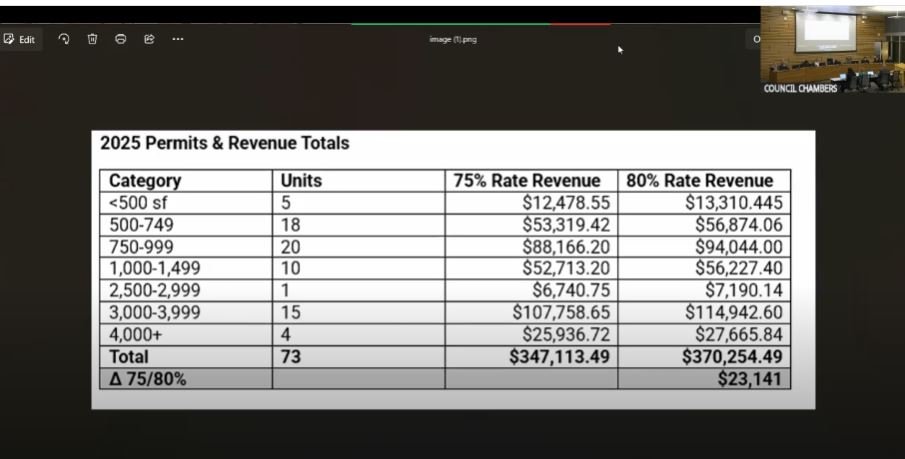
In response to CM questions, the following information was provided:
Q: What’s the difference between 75% and 80% in the PIF collection?
A: In 2025, they had 73 units that paid PIF and the difference between 75% and 80% was $23k. Year-to-date there have been nine permits, and that 5% difference is $4,123.
Q: What’s the cost to revise the PIFs?
A: Debbie said that they would have to hire a consultant to revise the rate study, then they’d have staff time and city attorney time. She doesn’t know the exact cost but it would be a few thousand at least for the consultant.
CM O’Cain said she was surprised that the difference between 75% and 80% is so small, especially given we’ve spent so much time on this. She asked Staff, rhetorically, if the cost of their time, work and the extra public hearing was more than we are going to recoup in PIF this year. Going forward, she asked Council to give special thought to the way meetings flow, to be mindful of staff’s time and City revenue. She’d like to be able to have one public hearing instead of two. They have a busy staff and many projects and this takes time and money away from higher-impact projects.
DM Sasson said that she appreciated CM O’Cain bringing up the issue of timely decision making. She wanted to point out that development is down because of tariffs, the immigration crisis, and diesel going up, and in her opinion it’s not because of PIF. She thinks this is back so that the full council can vote on 80%.
CM Loutsis said that they’d talked about a stepped provision at the last meeting, which they were just told that would be arbitrary. He brought up that a 500sf unit to a 4,000sf doubles in terms of fee but goes up 8x in terms of size. The problem he’s seeing is that square footage methodology is still tied to persons/unit. People living in condos are paying a larger proportional rate, vs. someone residing in a 4,000sf house. To him, that doesn’t seem fair or right, and it doesn’t make sense.
CM Culver, undeterred by Staff’s memo and presentation, made a pitch for housing-type specific fees. He quoted SB 5258 from 2023 and said it calls for proportionally lower impact fees for smaller units. He cited Commerce guidance, which he says allows the City to reduce or waive fees for smaller units, provided that it’s documented. He referenced Redmond, Bothell, Olympia, Renton and Sammamish as having housing-type specific fees and argued we could use it as a layer within the methodology for PIF. He wants to bring back a consultant to revise the methodology to reflect this.
MOTION: CM Culver moved to direct staff to incorporate housing type, as well as unit size, into the methodology Consistent with RCW 82.02.060. CM Adman seconded.
CM Loutsis said that he would like review and to better understand legal implications, since this is popping up out of nowhere. Code is a case-by-case basis for each city so he’d like a second set of eyes on this to ensure it would work for Kenmore. He believes that part of the issue with the current code as presented is the incorporation of the number of persons per unit, which throws off the proportionality. He clarified for other CMs that he has hesitations on the motion; while he understands most of the time that housing type makes sense, there could be variable conditions, and technicalities may be used to reduce fees when they otherwise wouldn’t be. He finds it really hard to do his own research when he’s blindsighted.
CM Marshall said that housing occupancy, or the number of people using the units, is really what they are looking at. He doesn’t see how the housing type determines the number of people who live there.
CM Culver offered code from Puyallup, Olympia, Redmond, etc., who show where the impact comes from. He said he emailed and floated this idea back in May and he’s been giving speeches about it since. He cited Redmond again, and the residential suites (co-living), and it’s 40% lower for what he called one of the most affordable housing types. He wants to mix and match the type and size distinctions.
CM Adman said that they were trying to put an affordability lens on there, and if they did housing unit type they could get towards that objective.
CM O’Cain reminded council that these PIFs are a regressive tax and they are ultimately paid for by the residents who live in the new construction. PIFs are paid for by the people who are building or buying in Kenmore, and these are our residents. It’s hard to slice this into a progressive tax. She would have liked Staff to have this information sooner, so that it could have been incorporated into the recommendations, and Council doesn’t have to keep coming back. Ultimately, Council has spent a lot of time on something with a small financial impact, and they should be looking for where they are going to be making a substantive budget in the long term, and what affordability really is. She said it’s irresponsible to move forward on this.
Mayor Herbig said he wishes this discussion had been had a few months ago, and it’s hard to know whether supporting this is a good or bad thing without independent analysis.
Debbie clarified that ADUs are exempt from impact fees. The 2023 legislation gave two options; calculate by bedrooms and calculate by square footage. She doesn’t know if the per person was a requirement in part of the methodology. Most other jurisdictions have done a square-footage fee, and she’s not clear if Redmond’s code has been updated. The recent ones that have included distinction, were Poulsbo, which included single-family vs. multi-family but no further distinction. Kirkland looked at stacked vs. non-stacked. If Council wanted to pass this motion, they would need to hire a consultant and come back with another rate study for consideration.
Motion failed 2-5 with CMs Culver and Adman in support.
MOTION: DM Sasson made a motion for PIF at 80%. CM Culver seconded.
CM O’Cain said that due to the unsubstantial increase, the previous public hearing, and the fact that they could move forward today, she doesn’t support this. She asked Council to give good consideration to how they vote tonight. They have the ability to let Staff get on to other more important things; they are moving into a budget cycle, and it’s probably going to cost more than $4k they might recover to bring it back for a hearing.
CM Loutsis asked if they changed the methodology would they need a consultant [yes].
CM Adman said that he wants to incorporate an affordability matrix, but also recoup as much as possible. He agreed with CM O’Cain that the real impact is not that much, and they’ve gone around with this a lot. He recognized they have the ability to vote on it and just be done.
CM Culver told people that they already voted on 80% and asked for a yes.
Motion passed 4-3 with CMs Adman, Marshall, Culver and DM Sasson in support. CM Adman and CM Loutsis had very long pauses before their votes.
Mayor Herbig said that he really hopes that we don’t have any more motions at the public hearing. CM Culver asked if they needed to vote on final adoption. Mayor Herbig said no, because they just made a substantive change and it requires another public hearing. They don’t know when the public hearing will be, since the schedule is quite busy.
INTERIM TRANSIT ORIENTE DEVELOPMENT (TOD) REGULATIONS
Presented by Debbie Bent and Samantha Loyuk and Brittany Chue. This is the draft code from the policy direction that Council gave at a previous meeting.
Brittany Chue presented. The TOD regulations were adopted in 2015 to create a walkable, multi-modal transportation zone close to SR522. In 2021, there was a six-month moratorium on development in the TOD because they were close to Swamp creek. Interim regulations were adopted, and a study was done by Osborne to rank the parcels on ecological function. They discussed prioritizing ecological preservation and housing affordability. Council gave direction to do the height incentive.
The proposal presented eliminates the TOD overlay zone; the parcels become Urban Corridor East and Urban Residential. This would make them compatible with other parcels. UR has lower (10%) affordability requirements, a lower street setback, and the proposal allows an increased height allowance to 85’ if developers restore or enhance the buffer. With UCE, the regulations already exist. Height would be the same, and there’s a 25% affordability requirement. The shoreline jurisdiction is not being changed.
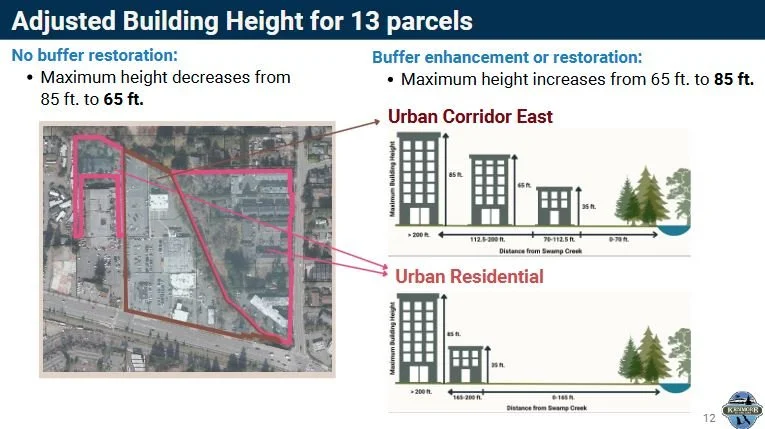
To get the mitigation bonus they’d have to submit Critical Area Report, Mitigation Report, and SEPA. The recommended design standard is Design Standard 1. This is what is used downtown and along SR 522. Brittany addressed the concerns from public comment about upcoming ecology rules, and why Staff is changing it now. The current “interim” rules have been in place since 2022, and the recommendation from Staff, and vote from council, was that they did not want to keep the interim regulations. Council and staff want to restore the buffer, but because there’s already existing development, the City either has to buy the property and conserve it, or try to incentivise redevelopment and enhancement. While there are draft regulations in the Ecology website, those are subject to change (they’re currently in the public comment period). Tentatively they will pass their new regulations in March.
The following are responses provided by Staff to CM questions:
Q: What level of affordability is required for 10% and 25% of the development:
A: 50% AMI for 25% of the units for TOD and UCE.
Q: What is the process when the new shoreline regulations and TOD guidelines come out. Will this have to be amended?
A: Brittany said that the new regs are going to be tentatively adopted in 2029. At that point, the shoreline regulations of the entire area would be evaluated, as well as buffers, heights, land uses. There would be community engagement and public hearings. There are manufactured housing communities in these areas and the Cities will have to do a displacement risk assessment. Debbie added that if we adopt the proposed regulations now, they are more consistent with the rest of the corridor and we are giving incentives to restoration. If the pending rules come out and they say we have to make changes, it would not just be for these 13 parcels, it will be for most of the corridor. In any land use scenario, if you adopt something there’s always a chance you have to make a change in the future.
Q: How large is the buffer? And what are they looking to do outside it?
A: Brittany said UCE is 70’ and with UR it’s 165’. Debbie said the shoreline designation is 200’, and there are regulations about what you can or can’t do within that designation. The West side of Swamp Creek can get closer since this was an already developed area, where the East side is smaller. They are only looking at changing what is allowed outside; they are not reducing the buffer because they don’t know what Ecology’s final rules and regulations will be.
Q: Why is Staff not proposing something that follows Ecology’s proposed rules now?
A: Brittany said the things that they are recommending are outside of their shoreline area. They do currently permit multi-family housing in the shoreline areas and critical areas. They are not trying to change anything precisely because of the new rules that are coming out; Staff is not recommending making those changes now because they have not been finalized. This will happen when the new recommendations next year. Debbie added that the draft makes sure that they stay out of the shoreline regulations; they are not amending them. When the final version comes out, those are the rules, and then the City has to figure out how to apply them to our shoreline. You can’t proactively do that until the rules are issued. Rules are released on rolling timelines, and they don’t come out at the same time so waiting for all the rules doesn’t work. There will always be new ones that come down the line. Debbie reminded Council that we have a legal risk of continuing the “interim” regulations that have been in place for such a long time.
Q: What is the timeline for the new regulations to be adopted?
A: Debbie said the new regs have to be adopted by June 2029, and this is a long process and usually takes 18 months as minimum.
Q: What is the process for extending the interim regulations?
A: If they extend, it requires another public hearing and then they can extend the regulations again for six months.
Q: If this is paused until March, how soon would it be back for a public hearing?
A: Debbie said Ecology issues the rules, then the City has to implement it. That takes 12-18 months for the City to adopt, then they go through Ecology with questions and comments, and then Ecology gives final approval. The March rules are just the start.
Q: Will implementing these regulations spur development?
A: Debbie said it sets the table; setting the table is one piece, but what will drive the market is whether financing and other things are available.
Q: Is there a way to tweak it so we adopt the amendments considering ecology rules?
A: Debbie said that we would go through a shoreline amendment process, but it would be a significant amount of work for a small part of the shoreline. Brittany said that they have been trying to not push the shoreline area, since they’re going to do that fully later. They could push the regulations to the parcels that are in that buffer, but whenever we mess with it we have to go through the full process of shoreline and ecology and they are not amending those buffers under this recommendation. They could incorporate some incentives, but that’s a more extensive process.
CM Culver said that he looked at the Commerce TOD guidebook and couldn’t find any other cities that are putting high-intensity TODs inside their shoreline environments, and he says that TOD legislation exempts critical areas from high-intensity TOD zoning. He asked for peer examples of high-intensity TOD in shoreline jurisdictions. He asked Staff why they weren’t following Ecology’s proposed rules now, or delaying until we have a full draft. He thinks we’re pushing changes that don’t incorporate the work. He took the opportunity to argue with staff about why they were adopting regulations now instead of waiting. He asked if there are any projects coming down the pike related to interim regulations [there are not]. He said “the community has been unanimous on this”.
CM Loutsis We can’t tell the future, and at least in this case we’re not talking about reducing the buffer, just changing what is outside of that.
DM Sasson said that this has been a long journey and Staff and Council have worked hard on this, and it speaks to their priorities on housing and environmental protection. She pointed to the public comments asking to extend the interim regulations, and asked about the timeline. She’s looking at this with the overlay of development being down.
CM O’Cain said that she remembers this from 2021, and then the PC dissenting opinion in 2022 that brought us to the current situation. She said she doesn’t love everything about the proposed code, but we want density and housing and things to move forward. If we pass this, it may be easier for people to look at purchasing properties and starting projects that would improve the city. She thinks getting this in place and closing the book is necessary. The thing that is most important after our staff time is the public hearing, and we want to hear from the community. Rather than just going back and forth with extensions, it makes sense to move forward so they don’t have to keep coming back.
Mayor Herbig said that he heard that if we wanted to restore that section of Swamp Creek we would have to purchase them, which we can’t, or wait for them to get redeveloped that would force the restoration.
CM Culver said that they will have the final copy of Ecology’s rule in January. He again pointed to Ecology’s upcoming regulations, the TOD guidebook, and he doesn’t believe we are in compliance with the process of incorporating TOD and shoreline regulations. He said that he called Ecology and they said an amendment wouldn’t get approved given this late hour in the cycle. He said that the legislature is stepping in to prioritize shoreline preservation over housing, even though we often pit them against each other. The priorities are environment, then single-family residential, and multi-family doesn't make the list. The Fed increased rates last week, which makes it harder to pencil, and WDFW had to halt fishing of salmon because the runs have been below recovery goals. He said that’s two emergency rules in three days over a run of fish. He argued to extend the interim regulations again.
MOTION: CM Culver moved to extend the regulations for six months. Motion died due to lack of a second.
MOTION: CM Loutsis moved to approve the staff recommendation to a public hearing. CM O’Cain seconded.
CM Marshall said he appreciated the massive amount of work, he’s a little uneasy from the 85’ height.
CM Culver said we’ve heard from the public on this and if they need to hear it again he’s happy to bring it back.
CM Loutsis says that the way he sees things is that we can freeze things the way they are, or we can keep buffers the same as they would be frozen and encourage developers to do their part by increasing affordable housing and incentivizing restoration. When the new requirements come from the state, we amend this down the road. He isn’t seeing the loss right now of moving forward since we’re not doing it at the expense of the buffers already there.
Motion passed 4-3 with CMs Culver, Marshall and Adman opposed.
STAFF REPORTS
City Manager Killgore reminded folks about the open house for Arrowhead. They originally started the design with seven speed cushions, and they will go into the nuance of what the design involves. Staff is in the budget cycle, and they will present the budget book October 5th at a special meeting, heading towards adoption in November. She reminded Council that Debbie Bent is the Deputy City Manager and Sam Loyuk is now the department head over the new Community Services Department.
COUNCIL REPORTS
CM O’Cain said she is enjoying the transition of fall color. She continued her statements of Free Palestine, and ending wars, and a prayer for our tax dollars to be spent on public good instead of war.
CM Marshall said congratulations to Sam and Debbie, and thanks to everyone involved in Oktoberfest. He attended three and it was hard work! He mentioned a busted up jersey barrier in 522, and would like the state to help fix it.
CM Culver said shout out to Earth, Wind and Fire.
CM Loutsis said that NPRSA had a meeting last week and picked an interim name for a future aquatic center while they prep for something more permanent.
DM Sasson thanked staff and the community who showed up tonight with comments and email messages. Council can’t be of service unless they know what the residents are thinking.
Mayor Herbig said that they make better decisions when they hear from people. He really enjoyed the weiner dog races. It’s the silliest thing you’ve ever seen.
